

Why do my feet smell bad after long work shifts on clinical rotations?
- It's the shoe, not your hygiene Clinical footwear traps sweat and heat in a sealed environment for 12+ hours, creating conditions where odor-causing bacteria multiply rapidly.
- Washing your feet isn't enough The bacteria live in a biofilm inside your shoe lining, not on your skin — post-shift treatment of the shoe itself is the only way to break the cycle.
- Prevention beats treatment Foot powder before the shift, a sock swap at the midpoint, and an immediate post-shift shoe spray are the three steps that actually control clinical shift odor long-term.

Why do your feet smell so bad after a long clinical rotation?
The smell isn't a hygiene failure — it's a physics problem. Clinical footwear is engineered to keep fluids out, which means it also traps sweat, heat, and bacteria in. After 12.5 hours of constant movement, the interior of a leather clog or treated sneaker becomes a warm, sealed environment where odor-causing bacteria reach concentrations that standard soap-and-water hygiene simply can't address after the fact.
The American Podiatric Medical Association notes that the average foot has over 250,000 sweat glands and can produce up to half a pint of moisture in a single day under normal activity. A clinical shift is not normal activity. You're logging 10,000 to 15,000 steps on hard floors, under fluorescent lights, in shoes that were designed for easy sanitizing — not breathability.
The result: your socks are saturated within the first four hours. After that, the moisture has nowhere to go. It pools in the footbed, wicks into the foam lining, and sits there — warm, protein-rich, and completely undisturbed — for the next eight hours.
That's the real problem.
Standard hygiene advice ("wash your feet thoroughly!") targets the bacteria on your skin. But by hour four of a clinical shift, the bacteria aren't primarily on your skin anymore. They're embedded in the lining of your shoe, feeding on a biofilm of sweat and dead skin cells that builds up with every step. Washing your feet at the end of a shift is closing the barn door after the horse is already gone.
What is the science behind why clinical footwear creates such aggressive odor?
The specific culprit is Brevibacterium linens, a bacterium that thrives in warm, moist, low-oxygen environments and produces methanethiol — a sulfur compound responsible for the distinct "cheesy" or sulfuric smell associated with medical locker rooms. The sealed, non-breathable interior of clinical footwear is essentially an ideal growth chamber for this organism.
Here's the material science angle that most people miss. The features that make clinical shoes functional — non-porous synthetic uppers, easy-wipe surfaces, sealed seams — are also the features that make them odor factories. A mesh running shoe allows moisture vapor to escape. A bromodosis-causing clinical clog does the opposite: it concentrates everything inside.
There's also a stress component that's specific to clinical environments. Research published by the International Journal of Dermatology has documented that emotional or psychological stress triggers eccrine sweat glands in the palms and soles — distinct from thermal sweating. Emotional sweat has a higher protein and lipid content than sweat from physical exertion alone. More protein means more food for bacteria, which means faster and more intense odor production. A nursing student navigating a high-pressure rotation isn't just sweating from the walking — they're sweating from the stress, too. And that sweat is richer.
Not even close to what a casual gym session produces.
The non-breathable material problem compounds over time. Each shift leaves behind a thin biofilm — a colony of bacteria embedded in a protective protein matrix — on the foam lining of the shoe. That biofilm doesn't disappear when the shoe dries. It goes dormant. Then your body heat reactivates it at the start of the next shift, and the cycle restarts from a higher baseline. This is why shoes that seemed manageable in week one of a rotation smell catastrophic by week four.
Most clinical workers apply deodorizing products to their shoes the morning before a shift — which is the least effective timing. Bacteria reproduce roughly every 20 minutes in warm, moist conditions. Treating your shoes immediately after removal, while the interior is still warm and the bacterial colony is most active, is significantly more effective than treating cold, dry shoes hours later. Think of it like cleaning a pan while it's still warm: the same effort produces far better results.
How do you actually stop the smell during and after a 12-hour shift?

The most effective approach targets moisture before the shift starts, not afterward. Applying a talc-free moisture-absorbing foot powder before your socks go on — not inside the shoe, but directly on your feet — creates a barrier that reduces sweat saturation in the first critical hours. Treating the shoes afterward with a targeted spray breaks down the proteins the bacteria feed on, addressing the source rather than masking it.
Here's the layered approach that actually works for clinical workers:
- Pre-shift: Apply a moisture-absorbing foot powder to clean, dry feet before putting on socks. This is the single most underused step. Powdering your feet, not your shoes, intercepts sweat at the source.
- Mid-shift (if possible): A fresh sock swap at the halfway point is remarkably effective. Changing socks around hour six removes the saturated layer before bacterial growth reaches critical mass. Compression socks with moisture-wicking fibers hold up better than cotton.
- Post-shift: Spray the shoe interior immediately after removing them — not the next morning. Bacteria reproduce every 20 minutes in ideal conditions; a 12-hour overnight rest period is essentially a bacterial incubation run.
For the post-shift spray, you want something that targets the protein compounds the bacteria feed on, not just a scented aerosol that covers the smell for an hour. The Natural Foot Powder and Extra Strength Shoe Deodorizer Spray bundle is built exactly for this two-stage approach — powder before, spray after — and it's the most logical system for shift workers dealing with chronic odor rather than occasional smell.
If you want the free version first: baking soda sprinkled directly into the shoe and left overnight does absorb some odor. It won't break down the biofilm, but it's a legitimate starting point that costs nothing.
Why does the smell stay in my shoes even after I wash my feet?
The smell persists because it's not in your feet anymore — it's in your shoes. Bacteria create a biofilm inside the seams, foam, and lining of clinical footwear that standard soap can't penetrate. Washing your feet removes surface bacteria but leaves the source colony completely intact, ready to re-colonize your clean skin on the next wear.
This is the "re-activation phenomenon" that catches most clinical workers off guard. A shoe sitting in your locker overnight might smell completely neutral by morning. The bacteria inside aren't dead — they've gone into a low-activity state due to the drop in temperature and moisture. The moment your foot goes back in and body heat raises the interior temperature to around 32–35°C (90–95°F), the colony reactivates within 30 to 60 minutes.
That's also why a single pair of clinical shoes is genuinely insufficient for back-to-back shifts. A shoe needs a minimum of 24 hours to dry completely — not just the outer surface, but the foam midsole and lining. Most clinical footwear has a thick EVA foam footbed that holds moisture for 18–24 hours in normal room conditions. If you're wearing the same pair on consecutive 12-hour shifts, you're putting a wet shoe on every single day. Check out this breakdown of whether rotating two pairs actually resolves the odor cycle — the answer is more nuanced than most people expect.
Two pairs, rotated on alternating days, with at least one full dry cycle between wears, is the structural fix. Everything else is maintenance.
What's the best long-term prevention routine for clinical shift foot odor?
Long-term prevention requires three things working together: a 48-hour shoe rotation, moisture-wicking socks (merino wool outperforms cotton by a significant margin in clinical settings), and a consistent post-shift deodorizing routine. Doing any one of these alone produces modest improvement; doing all three produces a genuinely different outcome.
On sock material: merino wool socks are meaningfully better than cotton for foot odor in clinical settings, not because of marketing, but because wool's natural crimp structure wicks moisture away from the skin and releases it as vapor rather than pooling it. Cotton absorbs and holds. In a 12-hour shift, that difference compounds dramatically.
On drying: if you have access to a boot dryer, use it. Boot dryers make a measurable difference for 12-hour shift workers because they cut the interior drying time from 18–24 hours down to 3–4 hours. That's the difference between a truly dry shoe and a shoe that's merely dry on the surface.
For targeted odor treatment, the Extra Strength Shoe Deodorizer Spray is worth having in your locker bag — a 2-second spray in each shoe immediately post-shift, before the bacteria have time to settle into another growth cycle. One honest note: the lemon eucalyptus scent is noticeable for the first 10 minutes after application, then fades to neutral. If you're spraying in a shared locker room, that's worth knowing.
The prevention routine doesn't need to be complicated. Powder your feet before the shift. Swap socks at the midpoint when you can. Spray the shoes immediately after. Rotate pairs. That's the whole system — and it takes about 90 seconds of your total day.
One thing most people never think to check: the insole. Most clinical shoe insoles are replaceable, and after 60 to 90 days of heavy use, they've absorbed enough biofilm that no surface treatment will fully eliminate the smell. Swapping insoles every two to three months is a cheap fix that makes a noticeable difference and gets overlooked almost universally.
Tired of your clinical shoes smelling worse every week?
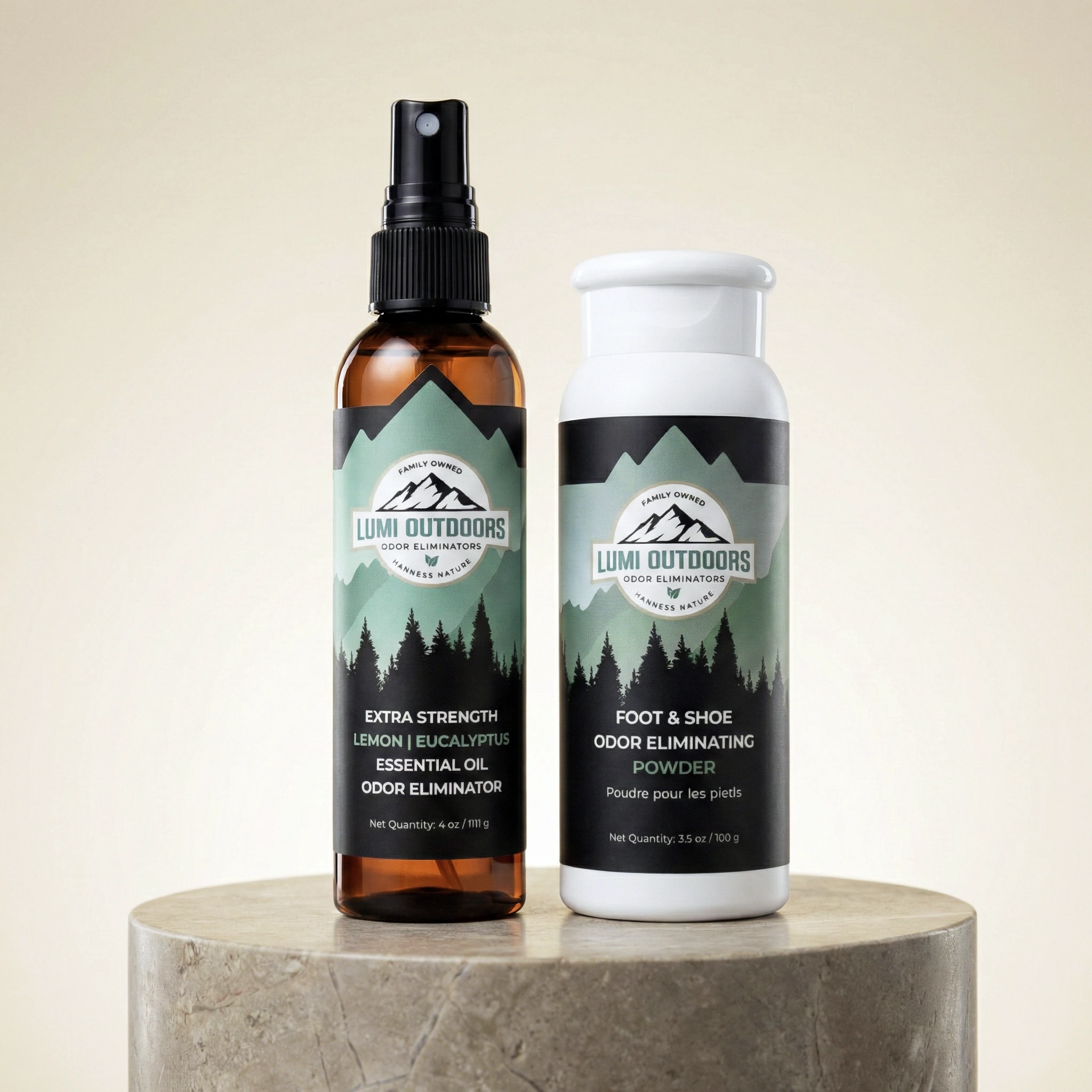
Join 1 Million+ Other People Who Chose Lumi to Conquer Their Shoe Odor.
- THE ULTIMATE 1-2 PUNCH AGAINST ODOR
- A COMPLETE KIT FOR SHOES, BAGS & GEAR
- PROUDLY FAMILY-OWNED & MADE IN UTAH
- THE "FRESH CONFIDENCE" GUARANTEE