
Why Freezing Your Shoes for Odor Is a Total Waste of Time
- Freezing pauses, not fixes Bacteria go dormant in the freezer and rebound fully once the shoe warms up — usually within 20 minutes of wearing.
- It damages your shoes Repeated freezing degrades EVA foam cushioning, weakens adhesive bonds, and dries out leather — shortening the life of expensive footwear.
- The real fix is two-part Proactive moisture control (powder before wearing) combined with a targeted essential-oil spray (after wearing) addresses both conditions that allow bacteria to grow.
- Check the mechanism, not the myth Any effective shoe odor solution must disrupt the bacterial environment, control moisture, and work inside an enclosed shoe — freezing fails all three.

Freezing your shoes does not eliminate shoe odor. It pauses it. The bacteria causing the smell go dormant at freezer temperatures, then wake back up the moment your shoes warm up — usually within the first 20 minutes of wearing them. You haven't solved the problem. You've just hit snooze on it.
This myth is everywhere — Reddit, TikTok, parenting forums, DIY blogs. And it makes enough surface-level sense that millions of people try it every year. This article breaks down exactly why it fails, what it actually does to your shoes, and what the science says works instead.
Why Do So Many People Believe Freezing Shoes Kills Odor?
The freezer myth persists because it produces a real, immediate sensory result — shoes genuinely smell less the moment they come out of the freezer, which most people interpret as proof that the bacteria have been eliminated. In reality, the cold has simply slowed bacterial metabolism to near-zero. The odor molecules that were already present have also partially condensed in the cold air, making the smell seem less intense. It's the same reason a carton of old leftovers smells worse on the counter than in the fridge.
The advice traces back to a simple, logical-sounding principle: cold kills germs. We've all heard it. It's why food safety guidelines recommend refrigeration, why some wound care protocols use cooling, and why "put it in the freezer" feels like a credible, science-adjacent solution. The advice spread on Reddit threads starting around 2010 and became a fixture on "life hack" lists, eventually reaching mainstream parenting and sports blogs as accepted wisdom.
But there's a meaningful difference between slowing bacterial activity and ending it. That distinction is the entire reason the freezer method fails.
What Does Freezing Actually Do to Odor-Causing Bacteria?
Standard home freezer temperatures (around -18°C / 0°F) do not kill the bacteria responsible for shoe odor — they push those bacteria into a dormant, suspended state called bacteriostasis, which reverses completely once temperatures rise back to normal. This is fundamentally different from a bactericidal outcome, where bacteria are actually neutralized.
The primary odor-causing organism in shoes is Brevibacterium — the same genus responsible for the smell of aged cheese like Limburger. It thrives between 20–37°C and produces isovaleric acid as a metabolic byproduct of breaking down leucine (an amino acid present in sweat). At freezing temperatures, its enzyme activity halts. But the organism itself remains structurally intact, essentially waiting.
According to research published in microbiology literature, many common shoe-dwelling bacteria — including Staphylococcus epidermidis and Bacillus subtilis — are classified as psychrotolerant, meaning they can survive and eventually recover from temperatures well below 0°C. The National Center for Biotechnology Information notes that bacterial dormancy under cold stress is a well-documented survival mechanism, not a vulnerability.
Think of it this way: frozen food can still carry Listeria or Salmonella. Freezing doesn't make food permanently safe — it just slows the clock. The same principle applies inside your sneakers. Dead quiet in the freezer. Very much alive at room temperature.
Most people spray the insole surface and call it done — but the real bacterial hotspot is the fabric sidewall of the toe box, not the insole. Bacteria migrate upward from the sole as the shoe warms during wear, colonizing the stitching and fabric liner where most sprays never reach. Tilt the shoe and spray along the interior sidewalls, not just straight down at the insole, for significantly better coverage.
What Happens When the Shoes Thaw? (It Gets Worse)

When frozen shoes warm back up to body temperature, dormant bacteria don't just resume normal activity — they often rebound aggressively, because the brief dormancy period can trigger a rapid reproduction cycle once conditions become favorable again. Add foot moisture to that equation and the environment inside the shoe becomes ideal for bacterial growth within minutes.
There's a secondary problem that almost no one talks about: condensation. When a cold shoe is exposed to warm air, moisture condenses on interior surfaces — foam, fabric, and liner material all absorb that condensation. You're essentially pre-moistening the shoe before you put your foot in it. Moisture is the primary driver of bacterial growth in footwear. The freezer method, counterintuitively, often makes the shoe environment more hospitable for odor-causing bacteria, not less.
Customer reviews on shoe care forums consistently report the same experience: shoes smell fine for the first few wears after freezing, then the odor returns at full strength — sometimes within 24–48 hours. That timeline tracks exactly with what we know about bacterial rebound post-dormancy.
So you've spent 8–12 hours of freezer time and a bag to achieve maybe one or two odor-free wears. That's not a solution. That's a very inconvenient delay.
Does Freezing Also Damage the Shoe Itself?
Yes — repeated freezing causes measurable damage to modern athletic footwear, particularly to EVA foam midsoles, adhesive bonds between the upper and sole, and any leather or synthetic overlay materials that rely on flexibility to maintain their structure.
EVA (ethylene-vinyl acetate) foam is the cushioning material in virtually every running shoe, cross-trainer, and athletic cleat made in the last 20 years. At sub-zero temperatures, EVA becomes brittle and loses its elastic recovery properties. A single freeze cycle may not cause visible damage, but repeated cycles gradually degrade the foam's ability to spring back — which is exactly the property you paid for in a $130–$200 pair of shoes.
Adhesives are even more vulnerable. The glues used to bond shoe soles — typically polyurethane or contact cement — experience thermal contraction stress during freezing. Over multiple cycles, this weakens the bond at the midsole-upper interface, eventually causing delamination. Shoe repair professionals see this pattern regularly in footwear that owners describe as "barely worn."
Leather boots are a special case. Leather contains natural oils that keep it supple; freezing draws moisture out of the material unevenly, causing cracking and stiffness. If you've been wondering whether it's safe to freeze leather boots: it's not. The cold dries out the leather fibers in ways that conditioning can only partially reverse. (For more on what actually damages leather, see our guide on rubbing alcohol and leather shoes — same principle, different chemical mechanism.)
So the freezer method doesn't just fail to fix the odor problem. It actively accelerates the degradation of the shoe you're trying to preserve.
Here's how common DIY methods actually compare on the criteria that matter:
| Feature | Natural Foot Powder and Extra Strength Shoe Deodorizer Spray | Freezer Method |
|---|---|---|
| Disrupts bacterial activity | Yes — essential oils lower surface pH and disrupt bacterial metabolism | No — bacteria go dormant and fully rebound at room temperature |
| Controls moisture | Yes — talc-free powder absorbs sweat proactively before odor starts | No — condensation from thawing actually adds moisture to the shoe interior |
| Works in enclosed shoes | Yes — spray and powder penetrate fabric and foam layers | Partially — cold reaches all areas but bacterial survival is the issue |
| Safe for shoe materials | Yes — no thermal stress, no adhesive degradation | No — degrades EVA foam, weakens adhesive bonds, dries leather |
| Odor-free duration | 24–48 hours with regular use | 1–2 wears before full rebound |
| Application time | 15-minute dry time required after spraying | 8–12 hours in the freezer required |
What Criteria Does an Effective Shoe Odor Solution Actually Need to Meet?
Based on the mechanics behind why the freezer method fails, an effective shoe odor solution needs to meet four specific criteria: it must disrupt the bacterial environment (not just pause it), control moisture at the source, work within an enclosed shoe environment, and avoid damaging shoe materials.
Let's trace each criterion back to what the teardowns revealed:
- Disrupts bacterial activity, doesn't just pause it. The freezer method fails here entirely. The bacteria survive and rebound. Any real solution needs to change the conditions that allow bacteria to thrive — not just lower the temperature temporarily.
- Controls moisture proactively. Condensation from thawing actually increases moisture inside the shoe. Effective solutions address moisture before it accumulates — through powder, natural moisture absorbers, or breathable materials.
- Works inside an enclosed environment. Sunlight and airflow (which we'll get to) are passive and require the shoe to be open. Most shoes spend the majority of their life closed. The solution needs to work in that context.
- Doesn't degrade shoe materials. Sub-zero temperatures damage EVA, adhesives, and leather. The solution needs to be chemically and physically compatible with the materials it's treating.
Run any DIY method through this checklist and most of them fail on at least two criteria. Baking soda, for example, does absorb some moisture — genuine partial credit there — but it sits on the insole surface and doesn't reach the fabric and foam layers where bacteria actually colonize. It also doesn't address the bacterial environment directly, so odor returns within a few hours as the pH inside the shoe normalizes. Useful in a pinch, not a system.
For a fuller breakdown of which natural remedies actually hold up, this guide on natural shoe odor remedies runs several of them through a similar analysis.
What Actually Eliminates Shoe Odor Instead of Just Delaying It?
The most effective approach combines proactive moisture control (applied before wearing) with a targeted spray that lowers the surface pH and disrupts bacterial metabolism — addressing both the conditions that allow bacteria to grow and the odor compounds they produce.
This is the logic behind a two-part system. You need a powder that creates an inhospitable environment for bacterial growth before it starts, and a spray that addresses active odor after the fact. Neither tool alone is as effective as both working together.
Look for a spray with natural essential oils — specifically eucalyptus or tea tree oil. These compounds lower the surface pH of shoe interiors and disrupt the metabolic activity of odor-causing bacteria without leaving residue that damages materials. The mechanism matters: you're changing the environment, not just masking the smell with fragrance.
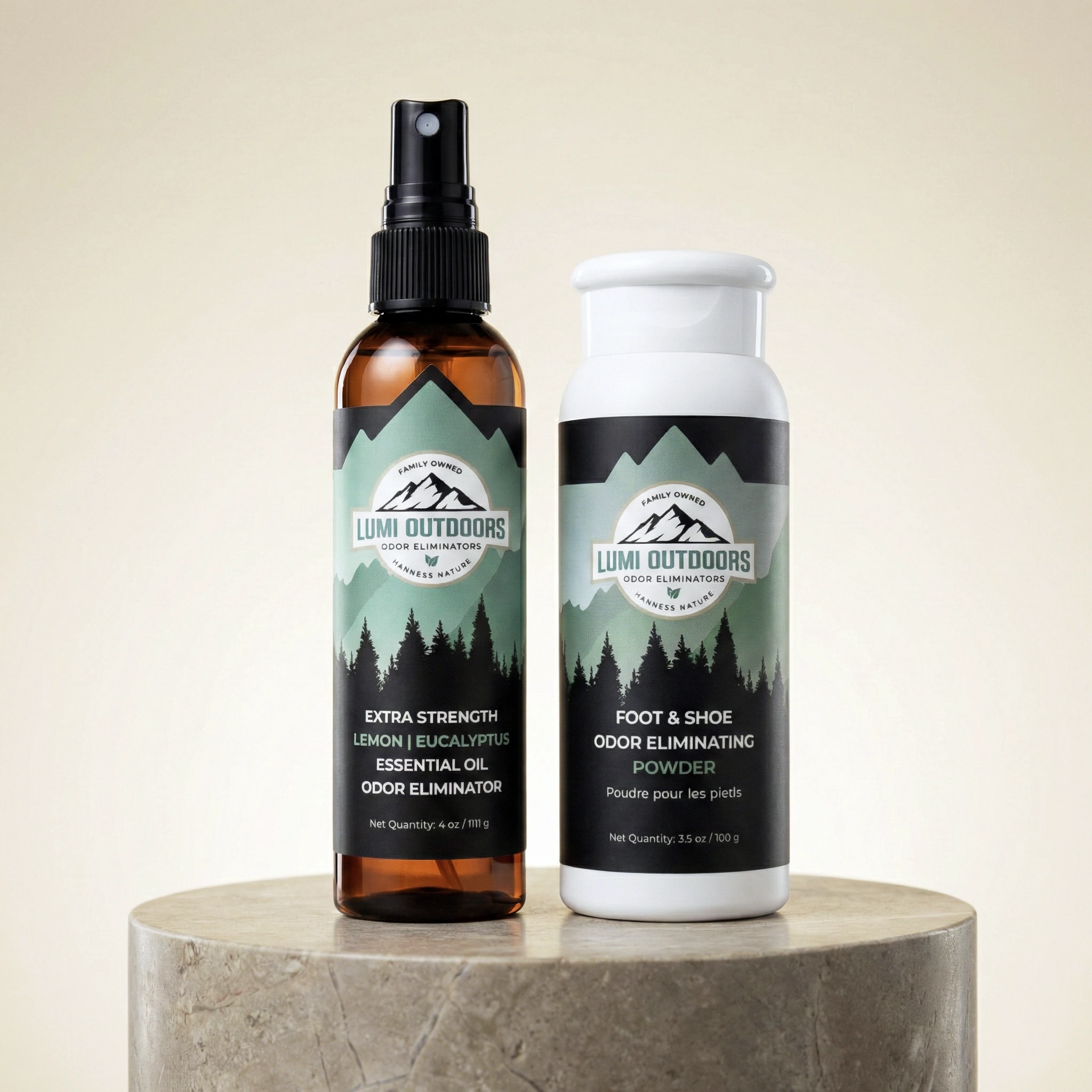
If you want a system built around exactly this approach, the Natural Foot Powder and Extra Strength Shoe Deodorizer Spray bundle from Lumi Outdoors pairs both tools in one kit — the powder handles proactive moisture defense, and the spray handles reactive odor elimination. This maps directly to the two failure points of the freezer method: it doesn't create moisture issues, and it actually disrupts the bacterial environment rather than temporarily pausing it.
One honest caveat: the eucalyptus scent in the spray is noticeable for the first 10–15 minutes after application, then fades to neutral. If you're sensitive to strong scents, spray the night before rather than right before wearing. It needs about 15 minutes to dry anyway before the shoe is ready to wear.
Dr. Scholl's Odor-X is worth mentioning here as a solid alternative for passive overnight use — it uses activated charcoal, which genuinely absorbs moisture and reduces odor compounds over 8+ hours. If you're looking for an insert-based approach, it's a legitimate option. Its limitation is the same as baking soda's: it works passively and doesn't reach deeply into foam layers where colonization happens. It's a strong supporting tool, not a complete system.
If you want to understand why washing your shoes often makes the odor problem worse before running to any product, this breakdown of why washing sneakers fails for post-workout odor is worth a read first.
If you've already got a stench emergency and need something that works today, check out the fastest way to neutralize shoe stench — it uses materials most people already have at home.
Here's a candid look at how the Lumi bundle holds up against the criteria we established — including where it has genuine trade-offs:
- Addresses both phases of the odor cycle — moisture prevention and active odor elimination
- Essential oil formula (eucalyptus + tea tree) changes the bacterial environment rather than masking smell
- Safe for EVA foam, leather, and synthetic materials — no thermal or chemical damage
- Powder works proactively, meaning odor never fully develops on heavy-use days
- Better long-term value than replacing footwear damaged by repeated freeze cycles
- Eucalyptus scent is noticeably strong for the first 10–15 minutes after spraying — spray the night before if you're scent-sensitive
- Requires a 15-minute dry time before wearing — not ideal for rushed mornings
How Do You Actually Use the Powder and Spray System?

Use the powder before each wear and the spray after — this two-step timing is what makes the system effective rather than redundant, since each product addresses a different phase of the odor cycle.
Here's the practical routine:
Before wearing: Tap a small amount of foot powder into the shoe, focusing on the toe box and heel cup where sweat concentrates. You can also apply it directly to clean, dry feet. The powder absorbs moisture throughout the day before it becomes a bacterial food source. A light coating is enough — you don't need to pack the shoe.
After wearing: Remove the insoles if possible and spray the interior of the shoe, including the insole surface and fabric lining. Let the shoes air out for at least 15 minutes before storing them. Don't close them in a bag or box immediately — trapped moisture undoes the work.
A detail worth knowing: if your shoes have a removable insole, washing the insole separately once a week dramatically extends how well any deodorizing system works. Insoles absorb the majority of sweat and bacteria, and most of them can be hand-washed with mild soap and air-dried in under 2 hours. This is the step most people skip — and it's the reason odor keeps returning even when they're doing everything else right.
Rotation matters too. Podiatrists generally recommend alternating shoes every 24–48 hours to allow EVA foam to fully decompress and dry. No deodorizer works as well in a shoe that's worn seven days straight. Build the rotation into the routine and the powder-spray system becomes noticeably more effective.
Done wasting overnight freezer space on shoes that smell again by noon?
Join 1 Million+ Other People Who Chose Lumi to Conquer Their Shoe Odor.
- THE ULTIMATE 1-2 PUNCH AGAINST ODOR
- A COMPLETE KIT FOR SHOES, BAGS & GEAR
- PROUDLY FAMILY-OWNED & MADE IN UTAH
- THE "FRESH CONFIDENCE" GUARANTEE