
Why Does My Shoe Smell Come Back Two Days After I Treat It?
- Surface sprays aren't enough Bacteria survive deep in foam insoles and fabric lining, then recolonize within 48 hours once your foot warmth and sweat return.
- You need to treat both shoe and foot Treating only the shoe re-infects it the moment you put it on — a complete fix addresses both sides of the equation at the same time.
- Moisture control breaks the cycle A foot powder before wearing combined with a 24-hour air-out after treatment starves the surviving bacteria before they can rebuild.

Your shoe smell returns in 48 hours because you're treating the surface, not the source. Standard sprays hit the top layer of bacteria, but the real population lives deep inside porous foam insoles and synthetic mesh — and the moment your foot heat and sweat return, the surviving colony rebounds fast.
Here's what a complete treatment protocol actually looks like — and why the "spray and wear" habit keeps you trapped in the same loop.
Why Does Shoe Odor Keep Coming Back Even After Treatment?
Shoe odor rebounds because most treatments address the symptom — the smell — without reaching the source producing it. The bacteria survive in a dormant state inside porous materials, then recolonize within one to two wear cycles once moisture and warmth return.
Think of it like the iceberg problem. What you smell is the top 10%. The other 90% is a dense microbial population living in the foam midsole, fabric lining, and insole — materials that are genuinely hard to penetrate with a quick surface spray. Bacteria like Brevibacterium and Staphylococcus epidermidis are the primary culprits behind that classic shoe smell, and they're remarkably well-adapted to surviving dry-out periods.
Here's the mechanism: when your shoe dries after a spray treatment, the bacteria don't die — they enter a low-activity state called dormancy. No food, no growth. The moment you slide your foot back in, you deliver everything they need: warmth (skin surface temperature around 90–95°F), moisture (the average foot produces about half a cup of sweat per day), and dead skin cells as a food source. Bromodosis, the clinical term for foot odor, is almost entirely a product of this bacterial metabolic activity — not the sweat itself.
The 48-hour mark isn't a coincidence. Under favorable conditions, bacterial populations can double roughly every 20 minutes, which means a small surviving colony can rebuild to odor-producing levels within one or two wears after an incomplete treatment. Surface sprays — especially fragrance-based ones — can actually make this worse by leaving behind organic compounds that feed the surviving bacteria.
That's the real problem.
Synthetic mesh sneakers and foam insoles are the worst offenders. Their porous structure gives bacteria a physical refuge that most liquid treatments simply can't reach in the concentration needed to neutralize the full colony. If you've ever treated your shoes thoroughly and still had the smell back by day two, that's almost certainly what's happening.
What Is the Recolonization Cycle and Why Is It So Hard to Break?
The recolonization cycle is a three-stage loop — residual bacteria survive treatment, enter dormancy, then rapidly regrow once foot heat and sweat return. Breaking the cycle requires disrupting all three stages simultaneously, not just masking the odor between wears.
Stage one is incomplete elimination. Most sprays don't penetrate deeply enough to reach the bacterial biofilm — a thin, protective layer that bacteria form on porous surfaces. According to research published through the National Institutes of Health on microbial biofilms, biofilm communities can be significantly more resistant to treatment than individual bacterial cells. Your insole foam is essentially a biofilm hotel.
Stage two is dormancy. Bacteria don't need favorable conditions to survive — they just need them to grow. A dry shoe after a spray treatment looks like a success. It's not. The population has simply paused.
Stage three is the rebloom. This is the part that fools people into thinking their treatment worked and then failed. It didn't fail — it was incomplete. The rebloom happens fast, which is why the smell is often back within two wears rather than two weeks.
Worth knowing: rotating shoes is one of the most effective tools in this fight, and it's free. The American Podiatric Medical Association consistently recommends alternating footwear every 24 to 48 hours to allow shoes to fully dry between wears. That drying time starves the bacterial colony before it can rebuild. If you're wearing the same pair every day, no single treatment will hold — you're re-inoculating the shoe before the treatment can do its job.
If you want to read more about why some shoes seem to develop problems suddenly even with good hygiene, this piece on why shoes suddenly stink even when you have perfect hygiene habits covers a few contributing factors most people overlook.
Most people spray their shoes and immediately stuff them back into a gym bag or closed closet — that's exactly the wrong move. Bacteria need moisture and warmth to recolonize, and a sealed bag provides both within minutes. After any treatment, leave shoes in open air with the tongue pulled back for a full 24 hours. If you can place a cedar shoe tree inside during that window, even better — it actively wicks residual moisture from the foam while the treatment is still working.
What Does a Complete Treatment Protocol Actually Look Like?

A complete protocol combines deep neutralization, moisture absorption, and drying time — in that order. Skipping any one step leaves the cycle intact. The goal is to eliminate the existing colony, remove the conditions for regrowth, and then maintain that environment between wears.
Step one is deep neutralization. High-concentration essential oils — particularly tea tree and eucalyptus — penetrate porous materials more effectively than water-based fragrance sprays because of their lower surface tension and oil-soluble chemistry. Apply your treatment spray while the insole is still slightly warm from a recent wear; the open pores absorb it more deeply. Let it sit for at least five minutes before wiping or drying.
Step two is moisture control. This is where most people have a gap in their protocol. A foot powder applied before wearing absorbs sweat before it reaches the shoe material, which means the bacterial population gets far less of the moisture it needs to rebuild. Baking soda sprinkled inside overnight is a solid free alternative — it absorbs residual moisture and shifts the pH toward alkaline, which bacteria find less hospitable. The real story on baking soda for shoe odor is worth reading if you want to know exactly what it does and doesn't do.
Step three is the 24-hour air-out rule. After treatment, shoes need to dry in open air — not a closed closet, not a gym bag. Forcing them back into a dark, humid space within a few hours undoes most of the work. Cedar shoe trees are excellent here: they absorb moisture from the inside while maintaining the shoe's shape, and the natural oils in cedar have mild odor-suppressing properties without any chemical residue.
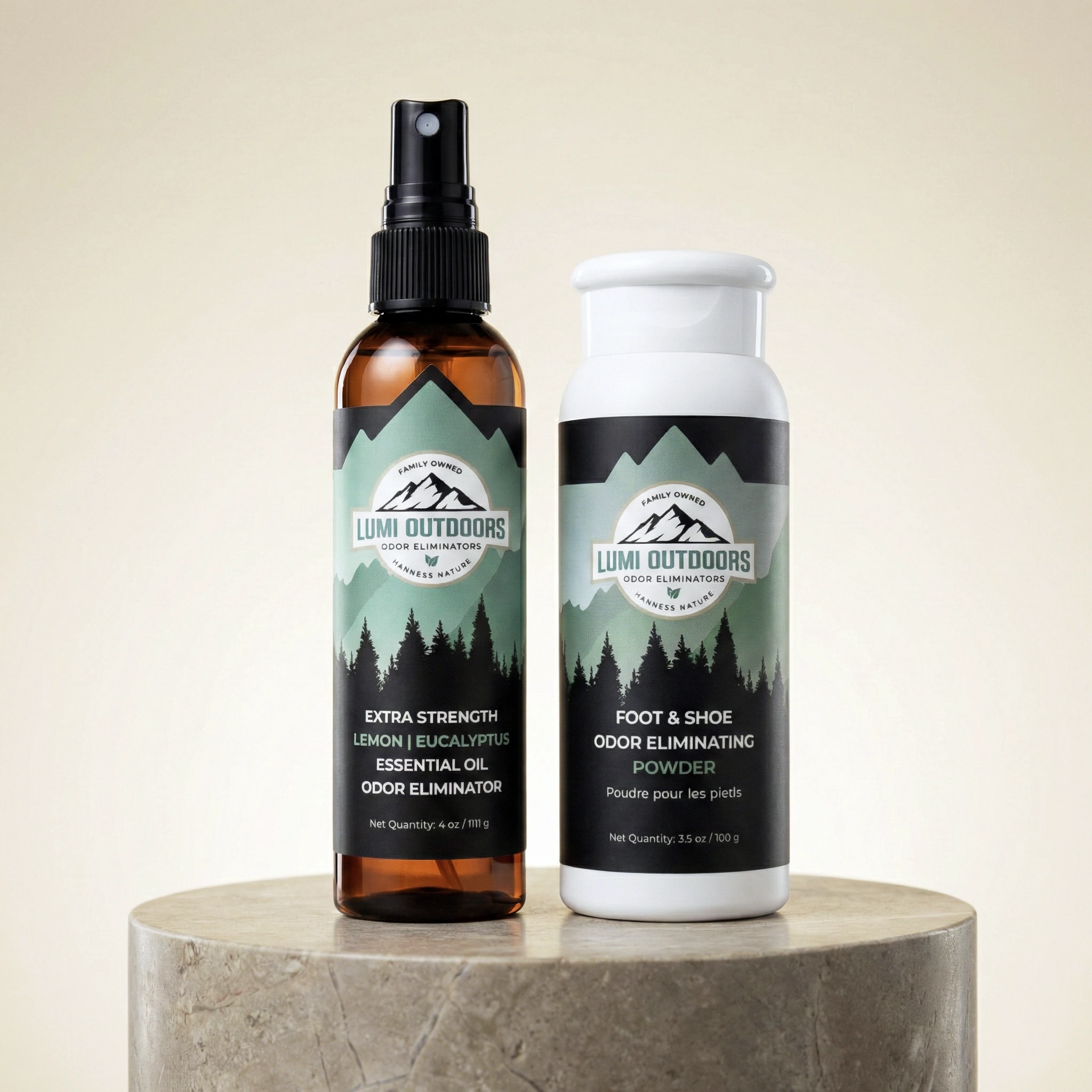
For a spray-and-powder system that handles both the neutralization and the moisture side of this equation, Lumi's Natural Foot Powder and Extra Strength Shoe Deodorizer Spray bundle is what we'd reach for — it's built specifically for people stuck in the "I've tried everything" loop. That said, the baking soda + cedar tree combination is a genuine standalone approach for anyone who wants to start with what's already at home.
Dr. Scholl's Odor-X insoles are worth mentioning as a complementary option — the activated charcoal format works well for passive overnight absorption between active treatments, particularly in work boots that can't be treated as aggressively.
Should You Treat Your Feet or Your Shoes First to Stop the Cycle?
You need to treat both simultaneously — treating only the shoe while ignoring the foot re-inoculates the shoe within minutes of wear, and vice versa. The foot and shoe function as a closed environment, and breaking the cycle requires addressing both sides of that system at the same time.
This is the cross-contamination loop that almost nobody talks about. A freshly treated shoe gets contaminated the moment a foot carrying a bacterial load steps inside. It works the other direction too: clean feet going into a poorly treated shoe pick up bacteria and carry them back to the skin. The cycle restarts with every wear.
The foot side of the equation matters more than most people expect. Hyperhidrosis — excessive sweating — affects roughly 3% of the population according to the American Academy of Dermatology, but many more people have mild versions that go undiagnosed. If your feet are unusually sweaty and standard treatments aren't holding, that's a real physiological factor — not a hygiene failure.
Moisture-wicking socks are an underrated tool here. Merino wool or synthetic-blend athletic socks move sweat away from skin contact significantly better than 100% cotton, which saturates and holds moisture against the foot and inside the shoe. Switching sock material alone sometimes changes the timeline of odor return noticeably.
And if you're dealing with persistent skin issues — cracking between toes, chronic itching, or a rash that doesn't respond to standard hygiene — that's worth a conversation with a dermatologist or podiatrist rather than a DIY solution. Some bacterial and fungal skin conditions require prescription treatment, and no shoe spray will resolve something happening at the skin level.
One last thing most articles skip entirely: replace your insoles. If you've been treating the same foam insoles for six months, the bacterial load embedded in that material may have crossed a threshold where surface treatment simply can't reach it anymore. A fresh set of moisture-wicking replacement insoles costs under $15 and effectively resets the clock — no amount of spray reverses a truly saturated insole. And if you want to see whether the freezer shortcut you've heard about is actually worth trying, this piece on the shoe freezer hack gives a straight answer.
Tired of treating your shoes only to smell them again two days later?
Join 1 Million+ Other People Who Chose Lumi to Conquer Their Shoe Odor.
- THE ULTIMATE 1-2 PUNCH AGAINST ODOR
- A COMPLETE KIT FOR SHOES, BAGS & GEAR
- PROUDLY FAMILY-OWNED & MADE IN UTAH
- THE "FRESH CONFIDENCE" GUARANTEE