
Should I treat my foot or my shoe first to fix the odor for good?
- Treat both simultaneously Treating only your feet or only your shoes creates a reinfection loop — bacteria transfer back and forth with every step, so one without the other never actually fixes the problem.
- The order matters Apply foot powder in the morning before putting shoes on, and spray shoes immediately after taking them off at night — not the next morning when populations have already rebuilt.
- Give it 7-10 days Shoe bacteria form biofilm communities in fabric and foam that require repeated treatment to break down — most people see major improvement by day 3, complete elimination by day 10.

Treat both at the same time — that's the only answer that actually works. Treating just your feet leaves bacteria colonies alive in your shoes, ready to reinfect clean skin with your very next step. Treating just your shoes means your sweaty feet reseed bacteria within hours. One without the other is a loop, not a fix.
Here's exactly why simultaneous treatment is the only way to break that loop — and the specific protocol to do it.
Why Does Treating Only One Side Always Fail?
Shoe odor is a two-population problem: bacteria living on your skin and bacteria colonizing the inside of your shoe are separate communities that constantly transfer back and forth, and eliminating one without the other guarantees reinfection within 24 hours.
Think of it like a ping-pong match happening inside your footwear. You scrub your feet, kill the surface bacteria, put on a shoe full of surviving colonies — and within one wearing, your skin is recontaminated. Flip that: you spray your shoes, neutralize what's inside, then slide in feet that are still hosting Brevibacterium and Staphylococcus epidermidis (the two bacteria most responsible for the classic "stale gym bag" smell), and the shoe is right back where it started by lunchtime.
That's the real problem.
The American Academy of Dermatology notes that foot odor — clinically called bromodosis — is driven specifically by bacteria that thrive in warm, moist environments. Your shoe creates exactly that environment, and your foot brings the bacteria to populate it. Neither half of this equation is optional to treat. This is also why shoe odor keeps coming back after treatment for so many people — they treated the symptom on one surface and called it done.
Are Foot Bacteria and Shoe Bacteria Actually Different Problems?
Yes — foot bacteria live in a warm, moist skin environment and produce odor directly from sweat breakdown, while shoe bacteria form protected biofilm communities in fabric and foam that are significantly harder to eliminate and require a different treatment approach entirely.
Your skin is a living surface. Bacteria there are metabolizing sweat compounds — specifically isovaleric acid, which is that sharp, vinegary note in intense foot odor. They respond quickly to washing, foot powder, and moisture reduction. The population turns over fast.
Shoe interiors are a different environment entirely. Bacteria in insoles and fabric linings form biofilm structures — layered communities that anchor to the material and resist simple surface treatment. A single spray application won't penetrate a mature biofilm the way it would clean skin. This is why deeply embedded shoe odor needs repeated treatment over several days, not a single blast of spray.
Worth knowing: shoes also hold heat and moisture long after you've taken them off, which means the bacterial population inside keeps growing for hours post-wear. If you're spraying shoes immediately before putting them on instead of immediately after taking them off, you're already a step behind. Spray on removal — that's when the population is at its peak and most exposed.
The two environments require different tools, used at different moments. That's the core insight most people miss, and it's exactly what makes shoes suddenly stink even with perfect hygiene feel so baffling.
Most people spray the insole surface and call it done — but the toe box lining and the lower sidewall fabric hold just as much bacterial load as the insole, especially in running shoes and cleats. Spray those areas too, then leave the tongue flap open while the shoe dries. A closed shoe traps the moisture the spray just displaced, and that defeats the whole point.
What's the Dual-Treatment Protocol That Actually Fixes This?

The protocol has two steps — foot powder applied to clean, dry feet before putting shoes on, and a deodorizing shoe spray applied immediately after removing them — repeated daily for 7 to 10 days to completely break the reinfection cycle.
Here's how to run it:
Step 1 — Morning foot treatment. After your shower, dry your feet completely (including between the toes — that's where moisture hides longest). Apply a talc-free foot powder to your feet before putting on socks. The powder's job is moisture absorption: fewer sweat compounds mean less bacterial activity, which means less odor produced throughout the day. Check out our breakdown of talc-free foot powder benefits if you're not sure why talc-free matters for daily use.
Step 2 — Evening shoe treatment. The moment you take your shoes off, spray the interior — insole surface, toe box, and sides of the lining. Don't wait until the next morning. The bacterial population is at its highest right after a full day's wear, and letting them multiply overnight in a closed shoe means you're starting the next day further behind.
Step 3 — Hold the line for 7-10 days. This isn't a one-and-done fix. The biofilm communities in shoe fabric take repeated treatment to fully break down. Most people notice a dramatic shift by day 3 or 4, but complete odor elimination typically takes a full 7-10 days of consistent dual treatment. Skip a day and you give the surviving population a chance to rebound.
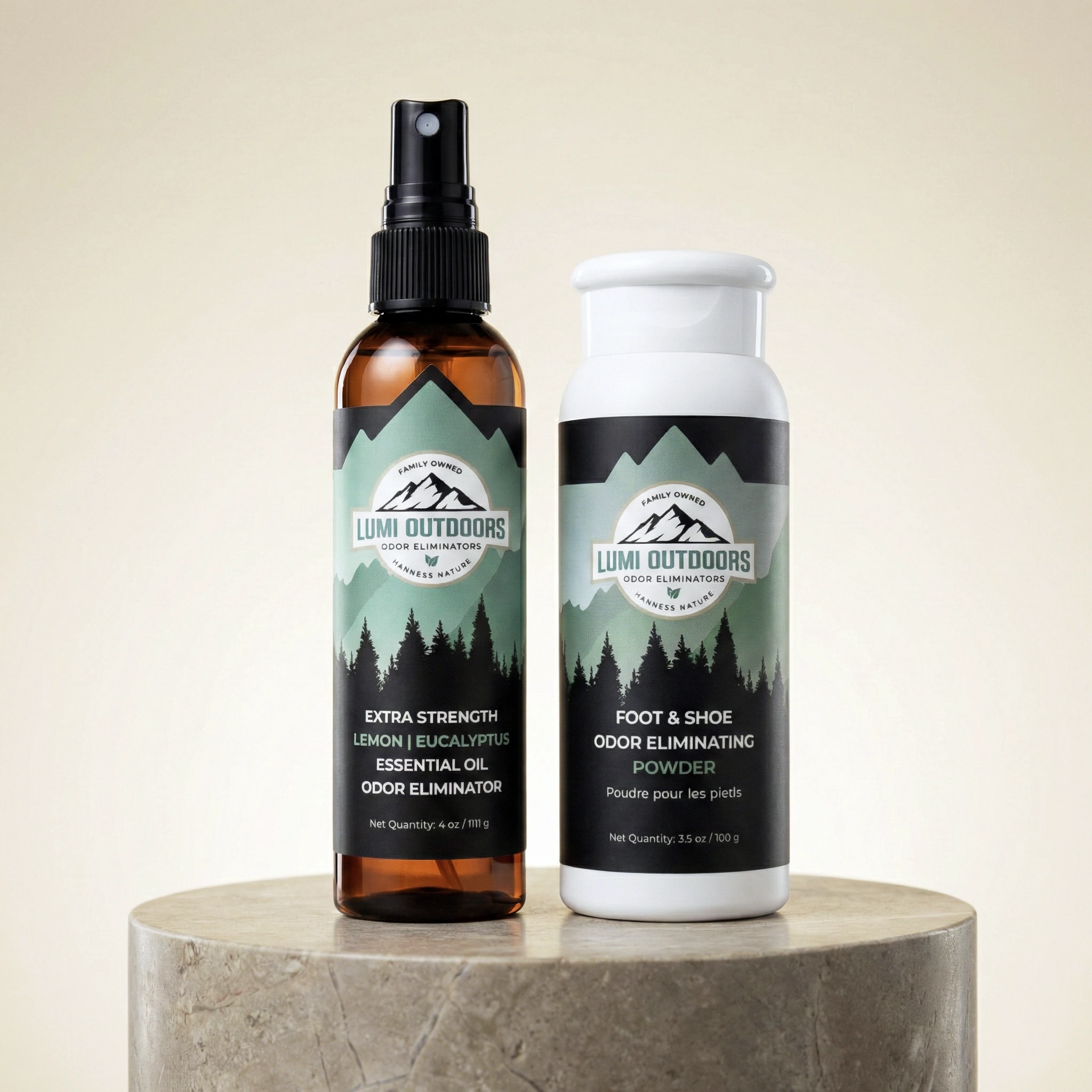
The most effective product I've seen for running both sides of this protocol is the Lumi Natural Foot Powder and Extra Strength Shoe Deodorizer Spray bundle — it's purpose-built for exactly this system. That said, if you want to start for free: plain baking soda sprinkled inside your shoes overnight and a thorough foot washing with a pumice scrub in the morning will give you a meaningful reduction in bacterial load without spending anything.
Cedar shoe trees are another solid, zero-cost-per-use option for the shoe side — they absorb moisture passively and release a natural scent that slows bacterial growth. They won't penetrate biofilm the way a spray does, but for prevention after you've done the initial treatment, they're genuinely useful.
What If You've Already Been Treating Just One Side?
Your partial treatment isn't wasted — you've lowered the bacterial load on one side, which gives you a real head start when you begin dual treatment. The reset is simple: deep-treat your shoes tonight and add the foot powder tomorrow morning.
If you've been treating only your feet, your shoes are the active reservoir. Before starting the full protocol, give your shoes an extended treatment: spray generously, stuff with newspaper to draw out moisture overnight, and let them air in a ventilated spot for at least 12 hours. That's your reset. Then start the dual protocol the next morning.
If you've been treating only your shoes, your skin is the reseeding source. Add a foot soak — warm water with a few tablespoons of white vinegar for 10-15 minutes — to drop the bacterial population before you begin. Vinegar changes the pH of the skin surface temporarily, making it less hospitable for odor-causing bacteria. It's a solid bridge while you get the full system running.
For prevention once you've broken the cycle, rotating your shoes every 48 hours makes a significant difference — it gives each pair time to fully dry before bacterial populations can re-establish. Pair that with moisture-wicking socks (merino wool outperforms cotton here), and you're solving the moisture problem upstream, which is what prevents odor from building in workout shoes in the first place.
Most people see dramatic improvement within 3-5 days of running both sides simultaneously, with full odor elimination by day 10. If odor persists past two weeks of consistent dual treatment, it's worth checking the insoles — heavily saturated insoles sometimes need replacement rather than treatment, since the biofilm has penetrated deeper than any spray can reach.
Ready to actually break the odor cycle instead of just managing it?
Join 1 Million+ Other People Who Chose Lumi to Conquer Their Shoe Odor.
- THE ULTIMATE 1-2 PUNCH AGAINST ODOR
- A COMPLETE KIT FOR SHOES, BAGS & GEAR
- PROUDLY FAMILY-OWNED & MADE IN UTAH
- THE "FRESH CONFIDENCE" GUARANTEE