
How to prevent odor in workout shoes with plant-based oils
- Masking doesn't work Synthetic fragrance sprays evaporate within minutes and leave the odor-causing bacteria completely intact — the smell always comes back.
- Two separate problems Workout shoe odor requires both moisture absorption (pre-workout powder) and odor neutralization (post-workout spray) — one product can't do both jobs.
- Plant-based oils address the source Terpene compounds in lemon eucalyptus and tea tree oil interact directly with bacterial cell membranes, providing lasting freshness rather than a temporary scent cover.
- The bag matters too Treating shoes while ignoring the gym bag lining restarts bacterial contamination every time you zip it up — weekly bag treatment is part of the protocol.

Baking soda, charcoal inserts, UV sanitizers, essential oil sprays, vinegar soaks — five common approaches to workout shoe odor, and the internet can't agree on which one actually works. We compared them across four criteria: odor elimination mechanism, duration of effect, safety profile, and cost per use.
Why Do Traditional Workout Shoe Deodorizers So Often Fail?
Most conventional shoe sprays mask odor with synthetic fragrances rather than neutralizing it at the source — which means the smell returns faster, often mixed with artificial fragrance, creating something worse than the original problem. Beyond the ineffectiveness, traditional aerosol deodorizers frequently contain phthalates and parabens, two chemical classes found in many synthetic fragrance formulas.
The American Podiatric Medical Association has long noted that footwear health extends beyond fit — it includes what your shoes are absorbing and re-releasing against your skin for hours at a time. If you're spraying a chemical cocktail inside your shoes every day, your feet spend all day in contact with whatever residue that leaves behind.
There's also a subtler issue. Synthetic fragrance molecules are volatile organic compounds — they evaporate fast. That's why a chemical spray smells "clean" for maybe 20 minutes, then the original odor reasserts itself. You haven't solved anything. You've just added a layer.
If your shoes smell bad despite normal hygiene habits, there's a biological reason for that — and it's worth understanding. Why shoes suddenly stink even when you have perfect hygiene habits breaks down exactly why this happens, and it's more common than most people realize.
What Is Actually Causing the Smell Inside Your Gym Shoes?
The odor in your workout shoes is produced by Brevibacterium and Staphylococcus species that feed on the amino acids in your sweat — the same metabolic process that produces isovaleric acid, which is responsible for the sharp, cheesy smell associated with gym footwear. It's not just sweat. It's sweat being consumed by bacteria, and the byproduct is what you're smelling.
Your gym shoe is actually a near-perfect bacterial environment: warm, dark, moist, and lined with synthetic mesh that retains moisture far longer than natural leather. According to research published in the National Library of Medicine, the interior of an athletic shoe can reach temperatures high enough to accelerate bacterial reproduction significantly within 30 minutes of exercise.
Heat isn't the only accelerant. A gym bag makes things worse. When you stuff warm, moist shoes into a closed bag immediately after a workout, you've created an anaerobic environment — no airflow, residual heat, trapped moisture. Bacterial colonies that might have slowed down with air exposure instead keep multiplying for hours.
The moisture question matters because it has two separate answers. You need something that absorbs sweat before it saturates the shoe lining, and something that eliminates the odor already present. These are different problems requiring different tools. Most single-product approaches only address one.
And if the odor coming from your shoes smells less like gym and more like something else — something sharper or more chemical — it may be worth checking whether it's a symptom of something more serious. If you notice redness, itching, peeling, or broken skin, stop treating the shoe and check with a doctor.
Most people spray the insole and stop there. The real bacterial hotspot in an athletic shoe is the toe box lining — the fabric that wraps around the front third of the shoe interior where toes compress during movement, trapping the highest concentration of sweat. Direct the spray nozzle toward the toe box at an angle and let it reach the back corners. That's where the smell is actually coming from, and it's the spot most spray applications completely miss.
How Do the Most Common Odor-Prevention Methods Actually Compare?
Evaluated across odor elimination mechanism, duration, ingredient safety, and cost per use, the five most-used methods — baking soda, charcoal inserts, vinegar soaks, UV sanitizers, and plant-based essential oil sprays — perform very differently, and the strongest choice depends on whether you're managing active bacterial colonies or preventing future growth.
Method 1: Baking Soda
Baking soda works by temporarily shifting the pH of the shoe interior. Brevibacterium and related odor-producing bacteria thrive in slightly acidic environments — the kind created by sweat — so introducing alkaline sodium bicarbonate disrupts that environment briefly. The mechanism is real.
The problem is duration. Multiple threads in r/Sneakers and r/Running report baking soda losing its deodorizing effect within 24–48 hours, as the bicarbonate neutralizes and the pH drifts back. And there's a more specific issue: when baking soda mixes with heavy sweat residue in athletic shoes, the reaction can produce a mildly unpleasant secondary odor. We've written about exactly why baking soda can make shoe smell worse when mixed with sweat.
Baking soda verdict: Free, accessible, and genuinely useful for mild, infrequent odor. Not a reliable solution for athletes with chronic or heavy-sweat shoe odor.
Method 2: Activated Charcoal Inserts
Activated charcoal works through adsorption — odor molecules and moisture bind to the porous surface of the charcoal material. Dr. Scholl's Odor-X line and several other brands use this mechanism, and it works well for passive overnight deodorizing. Leave charcoal inserts in your shoes for 8–12 hours and they'll pull a meaningful amount of moisture and odor compounds out of the material.
The limitation is that charcoal is passive. It can't do anything while you're wearing the shoes — it can only work after the fact, during the drying window. And it has a finite capacity. Once the charcoal is saturated, its effectiveness drops significantly without recharging (typically done by leaving inserts in sunlight). Cost per use runs moderate — quality inserts last a few weeks but need replacement.
Charcoal insert verdict: Genuinely excellent for overnight passive deodorizing. If you consistently leave your shoes somewhere you can insert charcoal packs every night, this is one of the better passive approaches available.
Method 3: Vinegar Soaks
White vinegar's acetic acid content creates an inhospitable environment for many bacteria. At concentrations around 5%, it can disrupt bacterial cell activity. Some athletes dilute it 1:1 with water and spray or soak insoles.
The practical problems are significant. Vinegar's acidic pH can degrade the adhesives used in athletic shoe construction over repeated applications, and the smell of vinegar itself — even after drying — lingers noticeably on synthetic mesh. Duration of effect is also short. The vinegar evaporates, and with it, most of the protective effect. It's not a terrible emergency option. It's a poor regular maintenance strategy.
Vinegar verdict: A reasonable one-time emergency intervention. Repeated use risks material damage and the trade of one unpleasant smell for another.
Method 4: UV Sanitizer Devices
UV-C light devices (SteriShoe is the most recognized brand) use ultraviolet light to disrupt bacterial DNA, reducing active bacterial populations inside the shoe. The mechanism is sound — UV-C exposure at sufficient duration and intensity genuinely reduces microbial load. The American Podiatric Medical Association has referenced UV shoe sanitizers as a valid tool for foot hygiene management.
The barriers are cost and convenience. Quality UV sanitizers run $50–$100+, require the shoes to remain stationary for 15–45 minutes per treatment, and only treat what the UV light can directly reach — meaning the light doesn't penetrate the toe box of a heavily structured shoe as effectively as the sole area. For someone managing a clinical foot condition, this investment makes sense. For preventing everyday gym shoe odor, it's probably more than you need.
UV sanitizer verdict: High-efficacy, high-cost, lower convenience. Best for households managing specific foot health concerns. Hard to justify as a daily-use odor prevention tool.
Method 5: Plant-Based Essential Oil Sprays
Lemon eucalyptus and tea tree oil contain terpene compounds — specifically 1,8-cineole in eucalyptus and terpinen-4-ol in tea tree — that neutralize odor compounds. The mechanism isn't masking. It's direct contact with the odor source.
The scent profile is worth noting honestly: lemon eucalyptus has a noticeable medicinal-citrus scent for the first 10–15 minutes after application, then fades to neutral. It won't make your gym bag smell like a spa. It also won't smell like a chemical factory. That neutral endpoint is what most people are actually looking for.
One real limitation: the spray needs approximately 15 minutes to dry before you should put the shoes back on. If you're in a rush post-workout, that's a genuine constraint. And plant-based sprays don't absorb existing moisture — they work best in combination with something that handles the moisture side of the equation, which is where a talc-free foot powder matters.
That's the core limitation. No single approach does everything.
Here's how the formulations compare across the four criteria we established upfront:
| Feature | Natural Spray + Powder | Charcoal Inserts | UV Sanitizer | Baking Soda |
|---|---|---|---|---|
| Odor elimination mechanism | Terpene compounds neutralize odor directly | Adsorbs odor molecules and moisture passively | UV-C light disrupts bacterial DNA during treatment cycle | Alkaline pH temporarily disrupts bacterial environment |
| Duration of effect | 24–48 hours per application | 8–12 hours passive overnight | Resets each treatment session (15–45 min) | 24–48 hours, then pH neutralizes and reverses |
| Works while wearing shoes | Powder active during wear; spray applied after | No — passive only when shoes are off | No — requires stationary treatment session | Limited — absorbs some moisture if sprinkled inside |
| Cost per use | Low — bundle provides ~60–90 applications | Low-moderate — inserts last 2–3 weeks each | High upfront — devices cost $50–$100+ | Essentially free — already in most kitchens |
| Ease of use | 2-step routine; 15 min dry time required | Insert and leave — zero effort | Set up device, wait 15–45 min per shoe | Sprinkle and leave — simple but messy |
| Addresses moisture + odor together | Yes — powder handles moisture, spray handles bacteria | Partial — absorbs moisture only | Bacterial only — no moisture absorption | Partial — mild moisture and mild pH effect |
What Is the Most Effective Protocol to Prevent Odor in Workout Shoes?

The most effective approach combines a talc-free moisture-absorbing powder before exercise with a plant-based essential oil spray immediately post-workout, followed by 15–20 minutes of open-air drying — addressing both the moisture environment that enables bacterial growth and the bacterial colonies themselves.
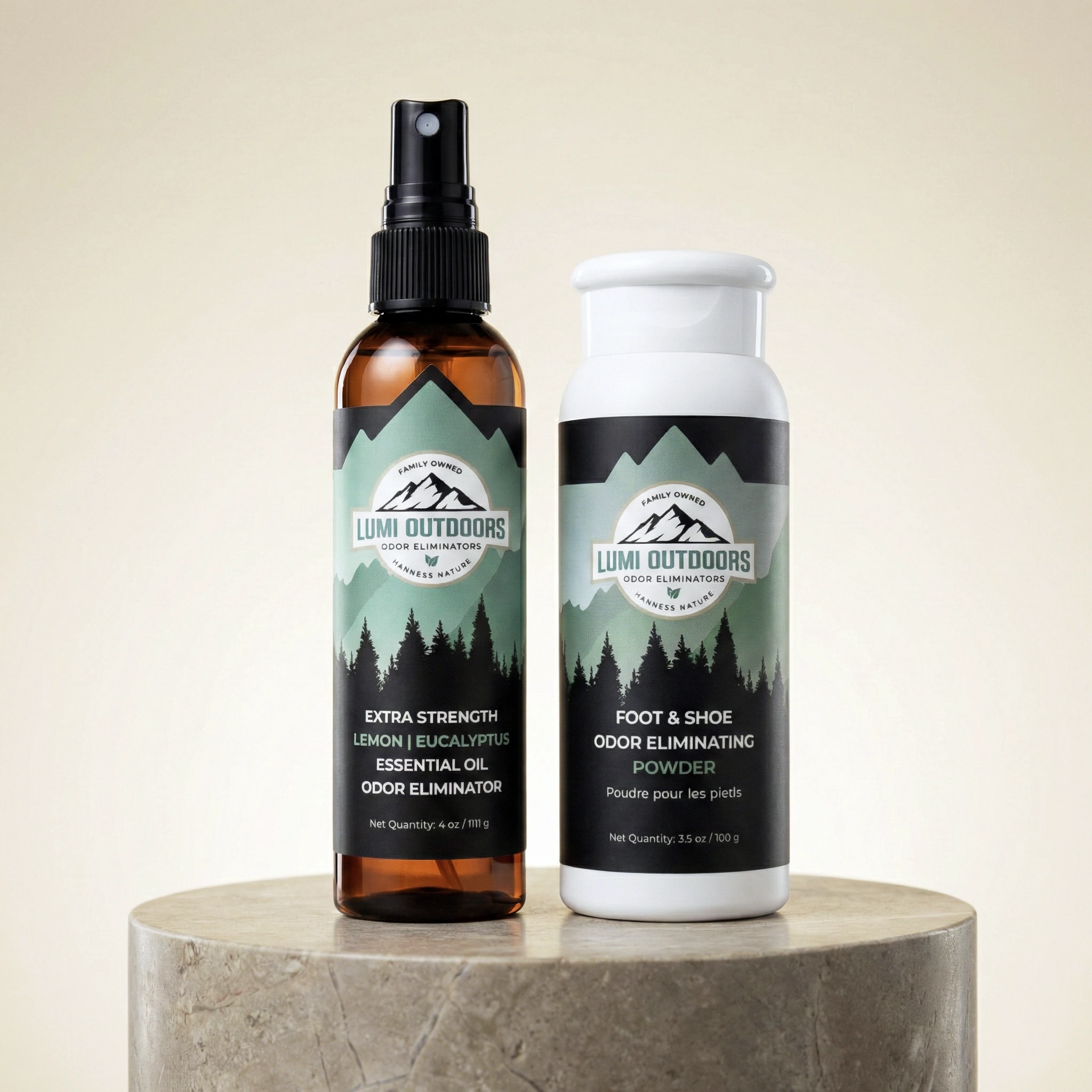
This is where a targeted system outperforms any single product. The Natural Foot Powder and Extra Strength Shoe Deodorizer Spray bundle is built around exactly this two-stage logic — powder handles sweat absorption before it saturates the lining, spray neutralizes odor after exercise.
What You'll Need
- Cedar shoe trees (for overnight moisture absorption and shape retention)
- Moisture-wicking athletic socks (merino wool or synthetic blend)
- Natural Foot Powder and Extra Strength Shoe Deodorizer Spray Check Price →
- Soft-bristled shoe brush (for clearing debris from mesh before treating)
The Pre-Workout Defense
Apply a light dusting of talc-free foot powder directly to your feet and inside the shoe before you put them on. This isn't about fragrance — it's about moisture management. The powder creates a barrier that slows the rate at which sweat saturates the synthetic mesh lining of your shoe. Less moisture saturation means a less hospitable bacterial environment throughout your workout.
Use a small amount. A light dusting is enough — heavy powder application clumps and can actually trap moisture rather than absorbing it.
The Post-Workout Reset
Remove shoes immediately after exercise and spray the interior — sole and side walls — with an essential oil-based deodorizing spray. The window matters. Bacterial colonies in a warm shoe are actively reproducing. Applying the spray while the shoe is still warm gives the terpene compounds better penetration into the shoe lining material than applying hours later when everything has dried and contracted.
Spray and leave the shoes open. Don't close them, don't put them in the bag, don't stuff them with anything for at least 15 minutes. Airflow during the drying window is non-negotiable.
The Drying Phase
Shoe rotation is one of the most consistently underrated aspects of odor prevention. The American Podiatric Medical Association recommends alternating athletic footwear every 24–48 hours to allow the EVA foam and synthetic fabrics to fully dry out. A shoe that gets worn every single day without a rest day never fully dries — which means bacterial conditions never fully reset.
If rotation isn't practical, cedar shoe trees are a solid alternative. Cedar is naturally moisture-absorbent and gives the shoe structure while drawing moisture out of the lining. This is a free or low-cost addition to whatever spray protocol you're using.
The Weekly Maintenance: Don't Forget the Bag
The gym bag is the overlooked contamination vector. If your shoes spend hours in a closed bag every week, the bag lining is accumulating the same bacterial load as the shoes. Spraying the shoes and ignoring the bag is like washing your hands and then immediately picking up a dirty towel.
Once a week, open your gym bag completely and spray the interior lining — including pockets where damp gear collects. The same plant-based formulas safe for shoe interiors are safe for most bag fabrics, including nylon and polyester linings. This approach works for yoga mats, lifting belts, and gloves too — anything that gets compressed in a warm, moist environment regularly.
For families managing multiple athletes, multiple types of gear, and multiple odor situations simultaneously, having variety in your spray kit makes practical sense. The Variety Bundle | 3-Pack (Lemon Eucalyptus, Citrus, Lavender) keeps a bottle in the entryway, one in the gym bag, and one wherever else the smell tends to collect — which is more useful than having a single bottle you're always moving around.
Most people never think about the bag.
What Is the Final Verdict on Preventing Workout Shoe Odor?
Based on the four criteria — elimination mechanism, duration, safety profile, and cost per use — plant-based essential oil sprays combined with talc-free powder provide the strongest overall system for preventing workout shoe odor, with charcoal inserts as a legitimate passive complement for overnight use.
Baking soda is genuinely free and worth trying for mild odor, but it won't hold up against heavy athletic use. Charcoal inserts are among the best passive overnight tools available. Vinegar is a reasonable emergency measure, nothing more. UV sanitizers are effective but hard to justify as a daily odor-prevention tool unless you're managing a specific foot health concern.
The plant-based spray approach wins on mechanism — it targets the odor source rather than masking it — and on safety profile, because the ingredients touching your feet all day matter. The honest limitation is the 15-minute dry time and the fact that it requires consistent use to stay ahead of bacterial buildup.
One specific tip that doesn't get enough attention: rotate your spray scents. Because terpene-based sprays work partly through direct contact rather than residual film, bacteria don't build up resistance the way they can to repeated identical chemical exposure. But rotating between lemon eucalyptus and citrus formulas keeps the intervention fresh and means you're less likely to habituate to the scent and start under-applying.
Ready to stop fighting the same gym shoe smell every week?
Join 1 Million+ Other People Who Chose Lumi to Conquer Their Shoe Odor.
- THE ULTIMATE 1-2 PUNCH AGAINST ODOR
- A COMPLETE KIT FOR SHOES, BAGS & GEAR
- PROUDLY FAMILY-OWNED & MADE IN UTAH
- THE "FRESH CONFIDENCE" GUARANTEE