

Stop! Don't Use a Shoe Ozone Generator Until You Read This
- They work, but at a cost Ozone generators kill odor-causing bacteria, but the same oxidation reaction degrades rubber, foam, and adhesives in your shoes over time.
- Closed-space use is a health risk Running one in a closet creates ozone concentrations well above safe indoor air limits — the EPA is explicit that effective odor-killing levels are also harmful to breathe.
- Moisture management beats oxidation A powder-and-spray system combined with 24-hour shoe rotation eliminates the bacterial conditions that cause odor without destroying your footwear.

Shoe ozone generators work — but "it kills the smell" isn't the full story. Ozone (O3) is a powerful oxidizer that breaks down the bacteria causing odor, but it oxidizes your shoe materials too. For occasional, well-ventilated use, the risk is manageable. For regular use on premium sneakers or work boots, you're trading the smell for structural damage.
Here's the part most Reddit threads skip: ozone doesn't care what organic material it reacts with. It'll break down the bacteria, sure — and then keep going through the rubber cement holding your sole together.
How Do Shoe Ozone Generators Actually Work?
Ozone generators produce O3 molecules that oxidize organic compounds on contact, including the odor-causing bacteria living in your shoes — but the same oxidation reaction degrades elastomers, adhesives, and foam, the three things that keep modern footwear intact.
Your shoe smells because of Brevibacterium and Staphylococcus epidermidis — bacteria that thrive in warm, dark, sweaty environments and produce isovaleric acid as a byproduct. That acid is the stink. Ozone molecules attack the carbon-to-carbon bonds in those bacteria and literally destroy them at a molecular level. Effective? Absolutely.
The problem is selectivity. Ozone can't distinguish between bacterial cell walls and the polyurethane foam in your midsole. According to the U.S. Environmental Protection Agency, ozone reacts with organic chemicals in the air and on surfaces, producing new byproducts that can themselves be harmful — and that same reactivity is what degrades rubber and synthetic materials over time.
The oxidation process works fast. Most shoe ozone devices run a 15–30 minute cycle, and at those concentrations, you're exposing your shoe's interior to levels well above the EPA's outdoor air quality standard of 0.070 parts per million. Inside a sealed shoe, concentrations can spike dramatically higher.
That's the real problem.
What Does Ozone Actually Do to Shoe Materials?

Ozone accelerates the breakdown of elastomers — the rubber and foam compounds in soles, midsoles, and glued seams — causing hardening, cracking, yellowing, and delamination with repeated exposure.
Modern sneakers and work boots are layered systems. The outsole is vulcanized rubber. The midsole is EVA foam or polyurethane. The upper is held together with polyurethane-based adhesives. Every single one of these materials contains the carbon bonds that ozone targets. Ozone cracking — the technical term for this degradation — has been documented since the early days of the rubber industry, and it's the exact reason tire manufacturers add antiozonants to their compounds.
The damage isn't always immediate. That's the frequency trap. One treatment might seem harmless. The midsole feels fine. The sole looks fine. But cumulative ozone exposure causes microfractures in the elastomer matrix that only become visible when the foam compresses under load — which is when you're wearing them, miles from home.
Signs of ozone damage to watch for:
- Hardened, brittle midsoles that no longer cushion
- Yellowing or browning on white rubber or plastic trim
- Delaminating soles where the adhesive bond has broken down
- Cracking along flex points in the outsole
If your $150 running shoes start delaminating after a few months of ozone treatments, the machine paid for itself in destruction.
Most people apply their shoe spray right after taking their shoes off and then immediately put them back in the closet — still damp, still warm. That's the worst possible storage condition: you're locking residual moisture and bacteria into an enclosed, oxygen-limited space right when treatment needs airflow to work. Give treated shoes 15–20 minutes in open air before storing them. The difference in how long the freshness lasts is significant.
Is It Safe to Run an Ozone Generator in a Closet?
No. Running an ozone generator in an enclosed space like a closet creates ozone concentrations that are dangerous to inhale — even brief exposure at elevated levels can cause chest tightness, coughing, and throat irritation, and the ozone lingers long after the machine shuts off.
This is the Reddit "life hack" that makes respiratory physicians cringe. The idea is to put the machine in the closet, close the door, run it for 30 minutes, and come back to fresh-smelling shoes. What actually happens: ozone concentrations in that enclosed space can reach levels 10–50x higher than outdoor air quality limits, and ozone has a half-life of roughly 20–30 minutes at room temperature. Open the door too early and you're breathing it directly.
The EPA is explicit on this. Ozone at concentrations that effectively neutralize odor-causing compounds is, by definition, at concentrations that exceed safe human exposure limits. There is no setting that is both "effective" and "safe for a closet." If you insist on using one, do it in a garage with the door cracked, leave the shoes alone for at least an hour afterward, and never run it in any space where people or pets spend time. Also worth reading: our breakdown of why many common shoe treatments create their own air quality problems.
Worth knowing: ozone also reacts with volatile organic compounds already present in your closet — off-gassing from clothing, shoe materials, and cleaning products — to create formaldehyde and ultrafine particles. The EPA flags this specifically as a concern with indoor ozone use.
So What Actually Gets Rid of Stubborn Shoe Odor?
The most effective approach targets both the bacteria and the moisture that feeds them, using a two-step system: absorb sweat before it creates a bacterial environment, then neutralize the odor-causing compounds that already exist.
Moisture is the root cause. Bacteria can't thrive in a dry environment. Your foot produces roughly 125ml of sweat per day — that's half a cup of moisture going directly into your shoe. Any odor strategy that doesn't address moisture is just masking the problem temporarily.
Step one is moisture management. Foot powder applied before you put your shoes on absorbs sweat throughout the day, which starves the bacteria of the conditions they need. Baking soda works as a free DIY option — sprinkle it into the shoe, leave overnight, shake out in the morning. It absorbs moisture and neutralizes some of the acid-based odor compounds. Cedar shoe trees are another solid tool: they wick moisture and maintain the shoe's shape while you're not wearing them.
Step two is rotation. Giving shoes a full 24 hours to dry between wears is one of the most effective, zero-cost interventions available. The EVA foam in most midsoles takes 18–24 hours to fully decompress and dry after a day of wear. Wearing the same pair every day keeps the environment perpetually damp and bacterial. For people with chronically smelly work boots, rotation alone often cuts the problem in half.
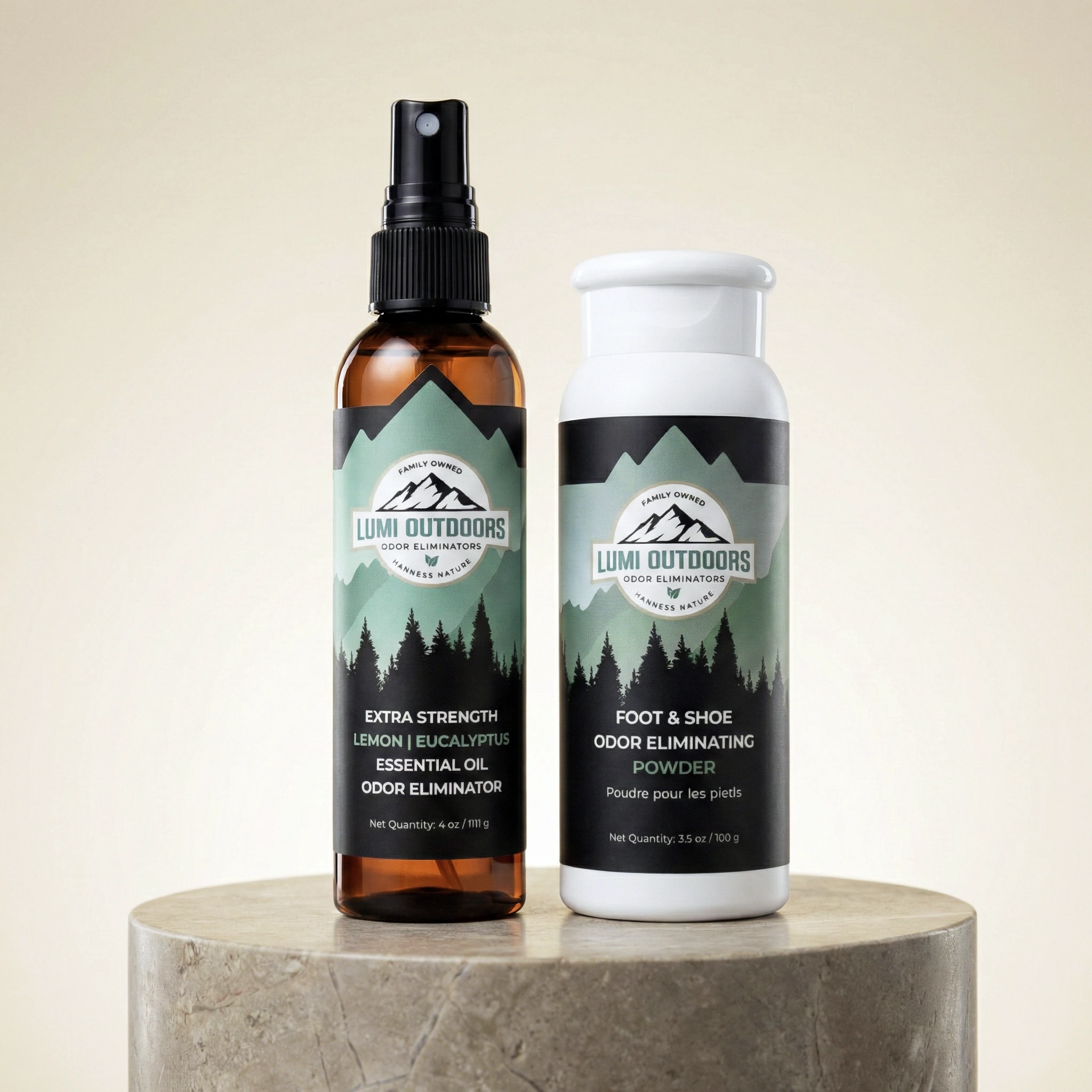
Step three is targeted neutralization. For shoes that already have embedded odor, a plant-based spray applied after each wear — not instead of moisture management, but in addition to it — treats the bacterial colonies directly. The Lumi Natural Foot Powder and Extra Strength Shoe Deodorizer Spray bundle is the combination we'd reach for here: the powder handles daily moisture prevention, the spray handles the odor that's already in the shoe. The two-step system is what makes it work. Neither product alone is as effective as using both.
If you want to go fully DIY, the combo of baking soda overnight plus a few drops of tea tree oil on a cotton ball left inside the shoe for a few hours handles a surprising amount. It's not as thorough as a dedicated spray, but it's free and genuinely effective for mild-to-moderate cases.
Does Ozone Damage Show Up Right Away, or Is It Gradual?
Ozone damage to shoe materials is cumulative and often invisible until the structural failure is sudden — a sole that delaminated overnight was actually degrading for months.
This is the cost-benefit math that makes ozone machines a tough sell. A decent ozone shoe deodorizer runs $40–80. A single pair of quality trail runners or work boots runs $120–200. Using a $60 machine four times a month on $150 boots for six months introduces significant cumulative oxidative stress to materials that weren't designed for it. The cracking and delamination that follows isn't covered by any shoe warranty.
Compare that to a systematic moisture-and-spray approach. Consistent daily use of a foot powder costs pennies per wear. Rotating two pairs instead of one is free. The shoe lives longer, smells less, and never needs an ozone machine in the first place. For more on why boot odor gets so extreme in the first place, the bacterial mechanism is worth understanding — once you see why the smell develops, the prevention steps make a lot more sense.
One last thing: if you're debating the ozone machine because you've already tried sprays and powders and the smell came back, the issue is almost certainly application timing. Most people spray shoes after wearing them and immediately return them to a dark closet while still damp. Apply the spray, let the shoes air out for 15–20 minutes in open air before storing them. That single change makes a noticeable difference in how long the freshness lasts.
Want to kill shoe odor without killing your shoes?
Join 1 Million+ Other People Who Chose Lumi to Conquer Their Shoe Odor.
- THE ULTIMATE 1-2 PUNCH AGAINST ODOR
- A COMPLETE KIT FOR SHOES, BAGS & GEAR
- PROUDLY FAMILY-OWNED & MADE IN UTAH
- THE "FRESH CONFIDENCE" GUARANTEE