
Lumi Outdoors vs Arm Hammer Deodorizer: Neutralize 90% of Boot Odor Naturally
- The Real Mechanism Boot odor comes from isovaleric acid produced by bacteria metabolizing sweat — not from sweat itself, which means covering the smell with fragrance never actually solves the problem.
- Where Baking Soda Falls Short Arm & Hammer's sodium bicarbonate is a solid overnight deodorizer, but it dissolves in sweat during active use, leaving you with fragrance on top of active bacterial metabolism by early afternoon.
- The Botanical Advantage Essential oils like tea tree and eucalyptus lower surface pH and interfere with bacterial cell membranes — two mechanisms that address the source of odor, not just the symptom.
- Timing Is Everything Spraying a warm boot immediately after removal gets botanical compounds deeper into the foam insole, where most of the bacterial load actually lives.

Your boots smell because of isovaleric acid — a compound bacteria produce when they break down sweat proteins trapped in leather and foam. The fix isn't spraying something on top of that acid. It's changing the boot's internal environment so bacteria can't produce it in the first place. That's a fundamentally different problem than most deodorizers are designed to solve.
For decades, Arm & Hammer has been the default answer for boot odor. It's cheap, it's everywhere, and it works — for a while. But if you're logging 10- to 12-hour shifts in steel-toes, something changes. The sweat volume is higher, the boot barely dries between uses, and by Wednesday, even fresh baking soda can't keep up.
That's where botanical formulas have started earning serious credibility on job sites.
Why Do Work Boots Smell So Much Worse Than Regular Shoes?
Work boots trap significantly more moisture than everyday footwear because of their non-breathable leather construction and the sheer volume of sweat produced during physical labor — up to 250ml of moisture per foot, per day according to the American Podiatric Medical Association. That warm, wet environment is exactly what odor-causing bacteria need to thrive.
Think of the inside of a work boot after a long shift as a petri dish with a rubber bottom. The leather upper doesn't breathe like mesh. The steel toe cap concentrates heat at the front of the foot. And the thick foam insole — great for shock absorption — acts like a sponge that never fully squeezes out overnight.
The primary culprit is Brevibacterium linens and related species from the Corynebacterium genus. These bacteria are the same organisms responsible for the smell of aged cheese — which is either fascinating or horrifying, depending on your day. According to microbiologist research summarized by Wikipedia's entry on bromodosis, these bacteria metabolize leucine from sweat into isovaleric acid, producing that sharp, persistent odor that's nearly impossible to ignore by end of shift.
The key word is metabolize. The bacteria have to be actively processing sweat to produce the smell. That's why timing matters — and why reactive deodorizing (spraying after the fact) is always fighting an uphill battle.
It's not just a smell problem. It's a chemistry problem.
Does Baking Soda Actually Eliminate Boot Odor, or Just Mask It?
Sodium bicarbonate (baking soda) neutralizes odor by raising pH in the boot environment, which temporarily disrupts bacterial activity. It works well for light, everyday odors but has two mechanical limitations: it doesn't address moisture buildup, and it loses effectiveness within a few hours of active use as sweat dilutes and re-acidifies the environment.
Arm & Hammer's deodorizer spray deserves credit for one thing: it's genuinely good at passive overnight odor control. The baking soda base is a legitimate pH buffer. If you spray it at night and your boots sit in a closet for 8 hours, you'll notice a real improvement by morning. That's not nothing.
But here's the mechanical limitation nobody talks about: sodium bicarbonate dissolves in moisture. The moment your feet start sweating during a shift, the baking soda gets diluted, the pH rises back toward neutral, and the bacteria resume business as usual. The synthetic fragrance that's blended in — usually a "clean linen" or "fresh" scent — keeps working for a while after the baking soda quits. So what you're smelling by noon isn't freshness. It's fragrance layered over active bacterial metabolism.
That's the masking problem in a single sentence.
Arm & Hammer also uses a propellant-based aerosol format, which means the active ingredients aren't penetrating deep into the foam insole where most of the bacterial load actually lives. It coats the surface — which helps — but it doesn't reach the core of the problem.
If you're not ready to spend money on anything, a white vinegar soak is a legitimate free alternative. Mix one part white vinegar with two parts water, wipe the inside of the boot with a cloth soaked in the solution, and let it dry completely for 4-6 hours. Vinegar's acetic acid drops surface pH low enough to disrupt bacterial activity, similar in principle to witch hazel. It won't last as long as an essential oil formula, and the smell while it dries is unpleasant, but it works. Doing this twice a week on a rotation keeps most moderate odors manageable — see our deeper breakdown on whether baking soda actually eliminates shoe odor for a side-by-side look at DIY methods.
Most workers treat the boot interior, but the insole undersurface is where bacterial density is highest — and it almost never gets treated because it's pressed against the boot floor. Pull the insole out once a week, spray both sides, and let it dry separately from the boot for at least two hours. This single habit makes a bigger difference than doubling spray frequency on the boot interior alone.
What's the Chemistry Difference Between Botanical Oils and Synthetic Fragrance?
Botanical essential oils like tea tree, eucalyptus, and lemon work through two mechanisms: they lower the boot's surface pH (disrupting bacterial metabolism) and their volatile organic compounds interfere directly with bacterial cell membranes. Synthetic fragrances are designed exclusively to smell good — they have no effect on the bacteria producing the odor.
Here's the condensed version for each main mechanism:
Lemon and eucalyptus oil are high in terpene compounds — specifically limonene and eucalyptol — that have documented surface activity against common foot bacteria. A 2019 review in Evidence-Based Complementary and Alternative Medicine found that eucalyptus oil demonstrated measurable activity against several Gram-positive bacteria strains, including those associated with foot odor. The effect isn't instantaneous, but it's cumulative: regular application builds an environment that's increasingly hostile to bacterial colonization.
Tea tree oil works differently. Its active compound, terpinen-4-ol, disrupts the outer membrane of bacterial cells, interfering with their ability to metabolize nutrients. Think of it like cutting off the bacteria's food supply rather than just changing the room temperature. The result is a reduction in active metabolic output — which means less isovaleric acid produced, not just masked.
Synthetic fragrances don't do either of these things. They're volatile compounds selected for their pleasant smell, full stop. The "fresh" scent in most commercial deodorizers is doing exactly what perfume does: occupying your nose's odor receptors with something more pleasant while the actual source continues unchanged beneath it. By hour four or five of an active shift, the fragrance fades and the underlying chemistry reasserts itself.
That's why you get the "funky chemical" smell some workers describe mid-afternoon — it's the synthetic fragrance degrading while the bacterial output continues.
Worth knowing: the lemon eucalyptus scent in botanical sprays is noticeable for the first 10 to 15 minutes after application, then fades to neutral as the volatile compounds disperse. You're not walking around smelling like a spa — the scent does its work and gets out of the way.
| Feature | Lumi Botanical Spray | Arm & Hammer Spray | White Vinegar DIY |
|---|---|---|---|
| Odor elimination method | Lowers pH + disrupts bacterial cell membranes via essential oil terpenes | Raises pH with sodium bicarbonate to temporarily buffer odor | Lowers pH with acetic acid to disrupt bacterial activity |
| Duration during active sweating | 8-12 hours; compounds penetrate foam insole and remain active | 2-4 hours; baking soda dilutes as sweat volume increases | 1-3 hours; acetic acid evaporates quickly with heat and moisture |
| Overnight passive deodorizing | Strong; botanical compounds continue working as boot cools | Very strong; pH buffering is well-suited to dry, passive conditions | Moderate; effective if applied and allowed to fully dry |
| Leather material safety | Compatible with leather and waterproof coatings; oil base is non-stripping | Propellant solvents can dry leather over repeated long-term use | Safe for leather when diluted; test on an inconspicuous area first |
| Cost per application | Moderate; 3-4 pumps per boot, ~90 applications per bottle | Low; widely available, inexpensive per-can cost | Very low; pantry staple with near-zero incremental cost |
| Scent profile | Noticeable lemon-eucalyptus for 10-15 min, then fades to neutral | Synthetic 'fresh' fragrance that fades by mid-shift | Strong vinegar smell during application; neutral once fully dry |
| Skin sensitivity risk | Low; no synthetic fragrances or parabens; trace limonene sensitivity possible | Moderate; synthetic fragrances are among the most common contact allergens | Low; diluted acetic acid is well-tolerated by most skin types |
Does a Natural Spray Actually Hold Up During a Full Work Shift?
Botanical sprays applied the night before a shift — when the boot is still warm and the bacterial load is highest — outperform morning applications because essential oil compounds penetrate deeper into leather and foam before the boot cools and contracts. Customer reviews of botanical formulas consistently report odor control lasting 8-12 hours on standard shifts.
This is the counter-intuitive part that most deodorizer guides miss.
Temperature matters. A warm boot is more porous than a cold one — the leather has expanded slightly, the foam is still soft from body heat, and the essential oil compounds can travel deeper into the material before drying. Spray a warm boot right after you take it off, and you're getting meaningful penetration into the insole core where the bacterial population is densest. Spray a cold boot the next morning and you're mostly coating the surface.
The overnight window is also when bacteria are most vulnerable. They've just finished a massive metabolic cycle during your shift. Their populations are high but their energy reserves are temporarily depleted. Applying a botanical formula during this window — rather than waiting until morning — means the active compounds are working against a fatigued bacterial colony rather than a recovered one.
Arm & Hammer's aerosol format doesn't benefit from this timing as much, because the propellant pushes the formula outward rather than inward. The mist settles on surfaces rather than penetrating them. It's a different delivery mechanism, and for boots with thick foam insoles, the surface-only approach has a ceiling.
We've also written about why foot odor gets so much worse during long shifts specifically — if you work in healthcare or any environment where you're on your feet for 8+ hours, this breakdown on foot odor during clinical rotations explains the moisture and pH dynamics in detail.
Which Formula Is Actually Safer for High-Quality Leather Boots?
Natural botanical sprays are generally safer for leather work boots than aerosol-based chemical deodorizers because they lack the propellant solvents and synthetic surfactants that can dry out, crack, or discolor leather over time. The essential oil base is compatible with most leather conditioners and doesn't interfere with waterproof coatings.
A good pair of work boots costs $150 to $400. Treating them with the wrong chemistry isn't just a skin issue — it's a materials issue.
Aerosol propellants (typically isobutane or propane in commercial deodorizer sprays) are mild solvents. They're not aggressive enough to visibly damage leather in a single application, but cumulative weekly use can strip the natural oils from leather, making it brittle and prone to cracking at the flex points near the toe box. If your boots are developing fine cracks at the bend point after a year of use, the deodorizer is one possible contributing factor.
Natural essential oil formulas don't have this problem. The oil base is compatible with — and in some cases complementary to — leather conditioning. Several leather care products actually use eucalyptus and tea tree oil as secondary ingredients precisely because they condition while they clean. For more on this, our piece on plant-based leather shoe spray goes deeper into material compatibility.
One thing to keep in mind: any liquid spray — botanical or synthetic — should be applied in moderation to waterproof boots. Saturating the inside of a waterproof boot can compromise the membrane over time. A light, even spray followed by a 15-minute dry time is the right protocol regardless of formula.
For workers with sensitive skin or contact dermatitis concerns, the difference is even more pronounced. Synthetic fragrances are among the most common contact allergens in personal care and shoe care products, according to the American Contact Dermatitis Society. Essential oil formulas aren't allergen-free — some people are sensitive to limonene — but the allergen profile is smaller and better understood.
If you're dealing with foot powder decisions alongside the spray question, our guide on talc-free foot powder benefits covers why the base ingredient matters as much as the active compounds.
Here's a product that brings both approaches — proactive moisture defense and reactive odor elimination — into one system designed specifically for this kind of use case.
What You'll Need
- Cedar shoe trees
- Soft-bristled shoe brush
- Natural Foot Powder and Extra Strength Shoe Deodorizer Spray Check Price →
- Moisture-wicking wool or synthetic socks
What's the Best 3-Step Protocol for Trade Workers to Eliminate Boot Odor?
The most effective protocol for trade workers combines pre-shift powder application (moisture prevention), immediate post-shift spray treatment (targeting bacteria while the boot is warm), and a 24-hour rotation cycle that allows each boot to fully dry. This three-layer approach addresses moisture, bacteria, and recovery time — the three root causes of persistent boot odor.
Step one is the one most people skip. Before you put your boots on in the morning, apply a light dusting of foot powder directly to your feet — not just inside the boot. A talc-free, arrowroot-based powder starts absorbing moisture on contact, keeping the skin surface drier throughout the shift. Arrowroot absorbs roughly three times its weight in moisture, which translates to a meaningfully drier sock environment by hour six compared to going without. Drier socks mean less moisture reaching the insole, which means less fuel for bacteria.
You'll want a soft shoe brush for this step to work properly — brush the inside of the boot before applying powder so you're not trapping debris under the fresh application. And if you use cedar shoe inserts, pull them before the brush step; they're for the dry phase, not the active-wear phase.
Step two is timing. The moment you pull your boots off at the end of a shift, spray the inside immediately — don't wait until morning. Spray 3 to 4 pumps into each boot, focusing on the toe box and insole, and let them sit open overnight in a ventilated area. The spray needs about 15 minutes to dry before you'd want to wear the boots again, but overnight gives it six to eight hours to work. This is the reactive half of the system.
Step three is rotation. Bacteria can re-colonize a boot within 24 hours if it never fully dries. If you only own one pair of work boots, the morning powder and evening spray protocol buys you time — but a second pair in rotation, even a cheaper backup, drops the re-colonization rate dramatically. The boots that dry for a full day between uses consistently smell better than boots used back-to-back, regardless of what you spray on them.
Insert cedar shoe trees into the boots after spraying. Cedar absorbs residual moisture and provides passive odor buffering overnight. They're worth the $15.
The protocol doesn't have to be complicated. Powder in the morning, spray at night, rotate when possible. Three things.
- Essential oil terpenes lower surface pH and interfere with bacterial metabolism — addressing the source of odor, not just the symptom
- Penetrates foam insoles when applied to a warm boot, reaching the highest-bacteria zones
- Compatible with leather, waterproof membranes, and most boot materials without stripping
- No synthetic fragrances — scent fades to neutral within 15 minutes of application
- Works as part of a two-product system with the foot powder for full-shift protection
- Needs approximately 15 minutes to dry before the boots can be worn — morning applications require planning ahead
- The lemon-eucalyptus scent is noticeable immediately after spraying, which some workers find strong in enclosed spaces like lockers
One final detail that most deodorizer guides never mention: the insole is almost always the primary odor source, not the leather upper. If you're deep-cleaning a boot that's been neglected for months, pull the insole out and treat it separately — spray both sides, let it dry fully outside the boot, then replace it. Treating the insole while it's inside the boot means the underside (where most bacteria live) never gets exposed to the treatment. That single step makes a bigger difference than most people expect.
Ready to stop fighting boot odor after every shift?
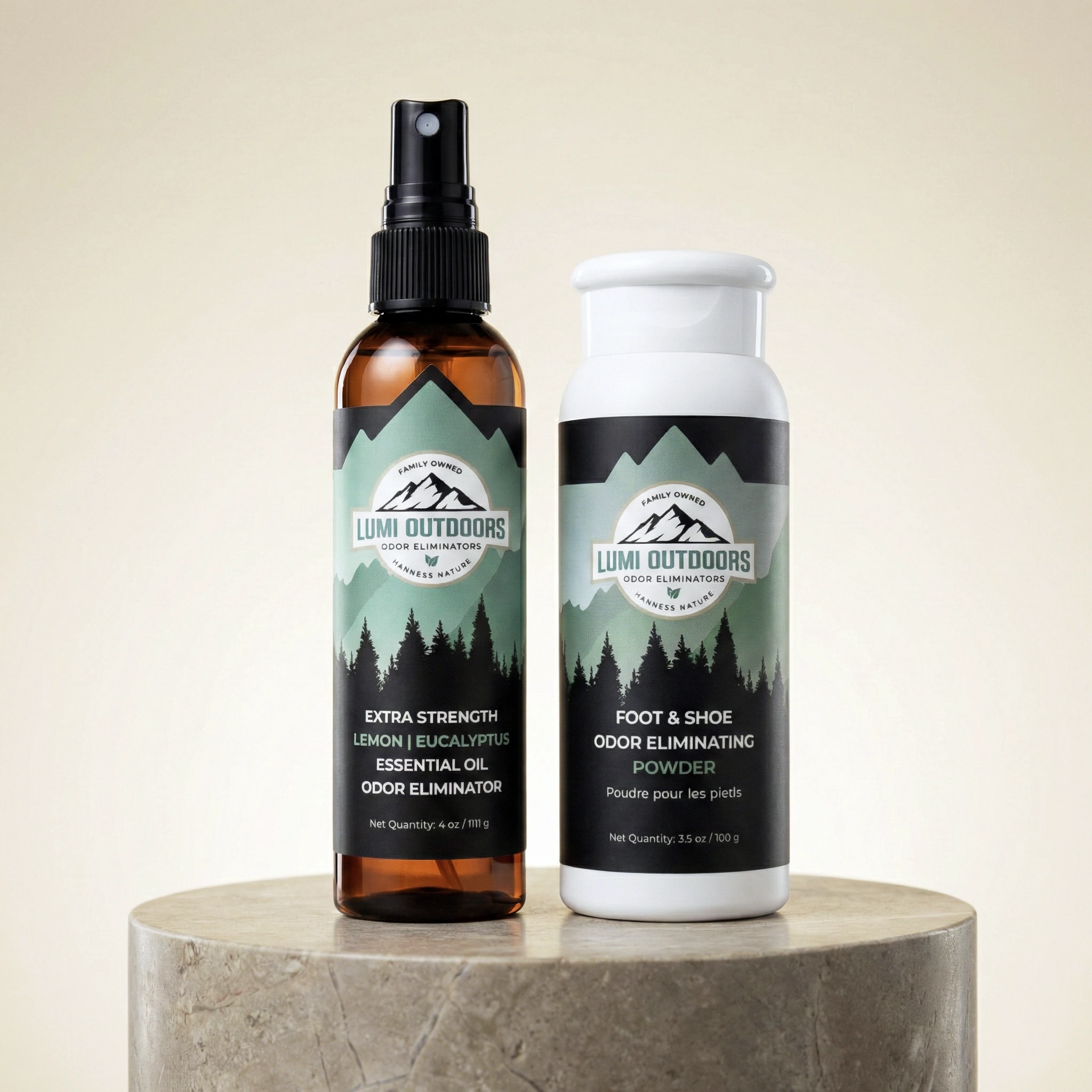
Join 1 Million+ Other People Who Chose Lumi to Conquer Their Shoe Odor.
- THE ULTIMATE 1-2 PUNCH AGAINST ODOR
- A COMPLETE KIT FOR SHOES, BAGS & GEAR
- PROUDLY FAMILY-OWNED & MADE IN UTAH
- THE "FRESH CONFIDENCE" GUARANTEE
Frequently Asked Questions
Is Lumi Outdoors spray safe for specialized footwear like steel-toe or waterproof boots?
How long does a bottle of Lumi last compared to a standard can of Arm & Hammer?
Will the essential oils in Lumi make my boots feel greasy or damp after application?
Can I use Lumi Outdoors if I have sensitive skin or allergies to synthetic perfumes?