
Leather Boot Odor Removal: Why Enzymes Outperform Chemicals for Leather
- Stop Using Chemical Sprays High-alcohol and synthetic-fragrance sprays strip leather's natural oils and combine with odor molecules to create worse smells, not better ones.
- Baking Soda Buys Time, Not a Fix It absorbs surface moisture and delays odor by 12-24 hours, but its alkaline pH can weaken leather fibers over repeated use and it never breaks down the embedded bacterial residues.
- Enzymes and Essential Oils Go Deeper Plant-based essential oil formulas penetrate the leather fiber matrix to disrupt bacterial activity at the source, without the solvents that dry out and crack the hide.
- Conditioning After Treatment Is Not Optional Any deodorizing treatment — even a gentle one — should be followed by a light leather conditioner to maintain suppleness and extend boot life.

Chemical sprays are the default recommendation for leather boot odor — and they're also one of the fastest ways to ruin a good pair of boots. The conventional wisdom here is genuinely backwards, and the chemistry explains exactly why.
Why Do Chemical Sprays Damage Leather Boots Over Time?
Chemical deodorizer sprays — particularly those built around high-alcohol bases or synthetic fragrance compounds — gradually strip the natural oils that keep leather supple, while doing almost nothing to address the actual source of the odor. Over repeated use, this creates a compounding problem: the leather dries out, the smell returns faster, and you spray more to compensate. It's a cycle that ends with cracked uppers and a boot that still reeks.
Here's the mechanism. Leather is a tanned animal hide with a porous, fibrous structure that naturally retains oils for flexibility. Most commercial deodorizer sprays contain alcohol concentrations between 60–80%, which is effective at surface disinfection on non-porous materials but acts as a solvent on leather's fatty liquor — the conditioning agents worked into the hide during tanning. A 2018 analysis published in the Journal of the American Leather Chemists Association noted that repeated alcohol exposure accelerates the oxidation of leather's lipid content, leading to measurable stiffness within weeks of regular application.
That's the real problem.
And then there's the masking issue. Synthetic fragrance molecules in aerosol sprays don't neutralize odor compounds — they compete with them. When you spray a heavily fragranced deodorizer into a boot that still contains isovaleric acid (the compound responsible for that sharp, sour foot smell), the two scents combine rather than cancel. The result is often worse than the original odor: a chemical-sweet smell that signals something is very wrong in there. Anyone who's ever over-sprayed a gym bag knows this combination exactly.
Leather also holds onto odors longer than synthetic materials because of its porosity. The same open fiber structure that makes leather breathable and durable creates deep channels where bacteria and their metabolic byproducts accumulate. A surface spray barely reaches this zone. The fragrance evaporates in hours; the bacteria and the isovaleric acid they produce do not.
Most people spray the center of the boot insole and call it done — but the toe box is where bacterial concentration is highest because it's the most enclosed, least-ventilated zone with the heaviest sweat load. Direct the first two seconds of every application toward the toe box specifically, then sweep back toward the heel. You'll get meaningfully better results from the same amount of product.
Does Rubbing Alcohol or a Strong Sanitizer Actually Eliminate Boot Odor?
Rubbing alcohol and chemical sanitizers can reduce surface bacteria temporarily, but they don't break down the odor-causing residues already embedded in leather fibers — and the drying effect on leather accelerates cracking within a few months of regular use.
The logic behind this approach makes sense on the surface. Alcohol is a proven disinfectant at concentrations above 70%, and if bacteria cause the smell, removing bacteria should remove the smell. The problem is a two-part failure.
First, the bacteria causing leather boot odor aren't primarily living on the surface. Species like Brevibacterium linens and Staphylococcus epidermidis colonize deep in the leather's fiber matrix, where they metabolize sweat into short-chain fatty acids. Isopropyl alcohol applied to the boot's interior reaches maybe the top layer of the material. The bacterial colony underneath? Largely untouched. The American Academy of Dermatology's guidance on skin barrier disruption parallels the leather problem precisely — aggressive solvents strip protective layers without addressing what's underneath.
Second, even where alcohol does reach bacteria, it's a temporary fix. The moment your foot goes back into the boot, moisture reintroduces the conditions for bacterial regrowth. Without removing the amino acid and protein residues that bacteria feed on, the colony rebuilds within 24–48 hours. You haven't solved anything. You've just bought a day.
The leather damage compounds this over time. Isopropyl alcohol at 70%+ concentration pulls moisture from leather at a measurable rate — studies on leather preservation consistently show visible surface cracking in test samples after as few as 10 alcohol applications. Work boots and quality dress boots can cost $200–$600. Treating them with repeated alcohol applications to save $15 on a proper solution is a losing trade.
Not even close.
Worth knowing: some people reach for white vinegar as a "natural" alternative to alcohol. Vinegar's acetic acid does lower surface pH, which temporarily disrupts bacterial activity. But at the 5% concentration in household white vinegar, the effect reverses within 4–6 hours as the acid evaporates and the pH normalizes. It's also a solvent on some leather finishes. Partial credit — it won't cause the same damage as isopropyl alcohol — but it's not a solution.
Does Baking Soda Actually Work for Leather Boot Odor?
Baking soda genuinely absorbs moisture and provides some short-term odor reduction, but its alkaline pH can interfere with leather's natural slightly acidic environment, and it doesn't address the bacterial proteins that are the real source of persistent odor.
This is the partial credit entry, and it deserves honest treatment. Baking soda — sodium bicarbonate — is a legitimate moisture absorber. Poured into a boot overnight, it can pull a meaningful amount of residual sweat from the insole. Less moisture means slower bacterial growth. For mild, occasional odor, this genuinely helps.
But baking soda has a pH of around 8.3. Healthy, well-conditioned leather sits at a pH of roughly 3.5–5.5. Repeated baking soda treatments shift the leather's surface chemistry toward alkaline, which weakens the collagen fiber structure over time. You won't notice it after one application. After months of regular use, the leather becomes brittle in ways that are easy to misattribute to normal wear.
The more fundamental limitation: baking soda doesn't break down the odor-causing compounds. Isovaleric acid and other volatile fatty acids are embedded in the leather matrix. Baking soda absorbs surface moisture but can't reach deep proteins. The odor returns reliably within 12–24 hours of wearing the boot again. It's a delay, not a fix.
Cedar shoe trees get partial credit for similar reasons. Cedar is genuinely effective at passive moisture absorption — quality cedar inserts can reduce interior boot humidity by 30–40% over an 8-hour period, which meaningfully slows bacterial metabolism. Dr. Scholl's Odor-X activated charcoal inserts work on the same principle and are a solid overnight option for passive moisture management. But neither cedar nor charcoal neutralizes the existing bacterial residues or breaks down the protein compounds that odor-causing bacteria feed on. They're the right component of a system. Not the whole system.
| Feature | Natural Enzyme Spray | Chemical Aerosol | Charcoal Inserts | Baking Soda |
|---|---|---|---|---|
| Breaks down odor compounds | Yes — essential oils disrupt bacterial metabolism at the fiber level | No — synthetic fragrance masks odor temporarily | No — absorbs moisture only, not odor compounds | No — absorbs surface moisture, not embedded residues |
| Safe for leather fibers | Yes — no solvents, pH-compatible with leather's 3.5–5.5 range | No — 60–80% alcohol strips leather's fatty liquor | Yes — passive, no chemical interaction with leather | Partially — alkaline pH (8.3) can weaken leather over repeated use |
| Odor control duration | 48–72 hours per application | 2–6 hours before fragrance fades | 6–8 hours passive overnight absorption | 12–24 hours before smell returns |
| Penetrates leather matrix | Yes — liquid formula absorbs into fibers | Partial — surface aerosol, limited penetration | No — sits inside boot, no fiber contact | No — powder rests on surface only |
| Upfront cost | $12–$18 per bottle | $5–$10 per can | $10–$20 per pair of inserts | $1–$3 per box |
| Zero-effort application | Requires a 15-minute dry time before wearing | Spray and go — no wait time | Drop in boot and leave overnight | Pour in, leave overnight, shake out |
What Does an Effective Leather Boot Deodorizer Actually Need to Do?

Based on how leather holds odor and why common methods fail, an effective leather boot deodorizer needs to break down protein-based odor compounds, work within the leather's porous fiber matrix, maintain a pH compatible with leather chemistry, and avoid solvents that strip the hide's natural conditioning.
Each criterion comes directly from the teardowns above. Let's make them explicit:
- Break down proteins, not just mask them. Isovaleric acid and its relatives are the end products of bacterial protein metabolism. A solution that doesn't address these compounds — either by disrupting bacterial activity or breaking down the metabolic residues — leaves the source intact. Fragrance masks; it doesn't fix.
- Penetrate beyond the surface. Surface-only solutions (alcohol wipes, baking soda) fail because the bacterial colony lives in the leather matrix. The treatment needs to reach the fiber level, which means it needs to be in liquid form and low enough viscosity to absorb into the material.
- Be pH-compatible with leather. The solution's pH should stay within or close to leather's natural 3.5–5.5 range. Strongly alkaline or strongly acidic solutions damage leather chemistry even when they address odor.
- Contain no high-concentration solvents. Alcohol above ~30%, acetone, and similar compounds dissolve the fatty liquor that keeps leather supple. Any effective leather deodorizer has to work without these.
That's the checklist. Now the question is what actually meets all four criteria.
What's the Best Natural Approach for Leather Boot Odor Removal?
Essential oil-based sprays — particularly formulas built around eucalyptus and lemon oil — address all four criteria: they disrupt bacterial activity at the fiber level, maintain a pH compatible with leather, contain no high-alcohol solvents, and don't leave synthetic fragrance residues that combine with odor molecules.
Essential oils work through a different mechanism than chemical sanitizers. Lemon eucalyptus oil, for instance, contains cineole and citronellal, which disrupt bacterial cell membranes without the pH-stripping aggression of alcohol. The result is a reduction in bacterial activity that lasts significantly longer than alcohol's short window — customer reviews consistently report 48–72 hours of odor control per application, even in heavily worn work boots.
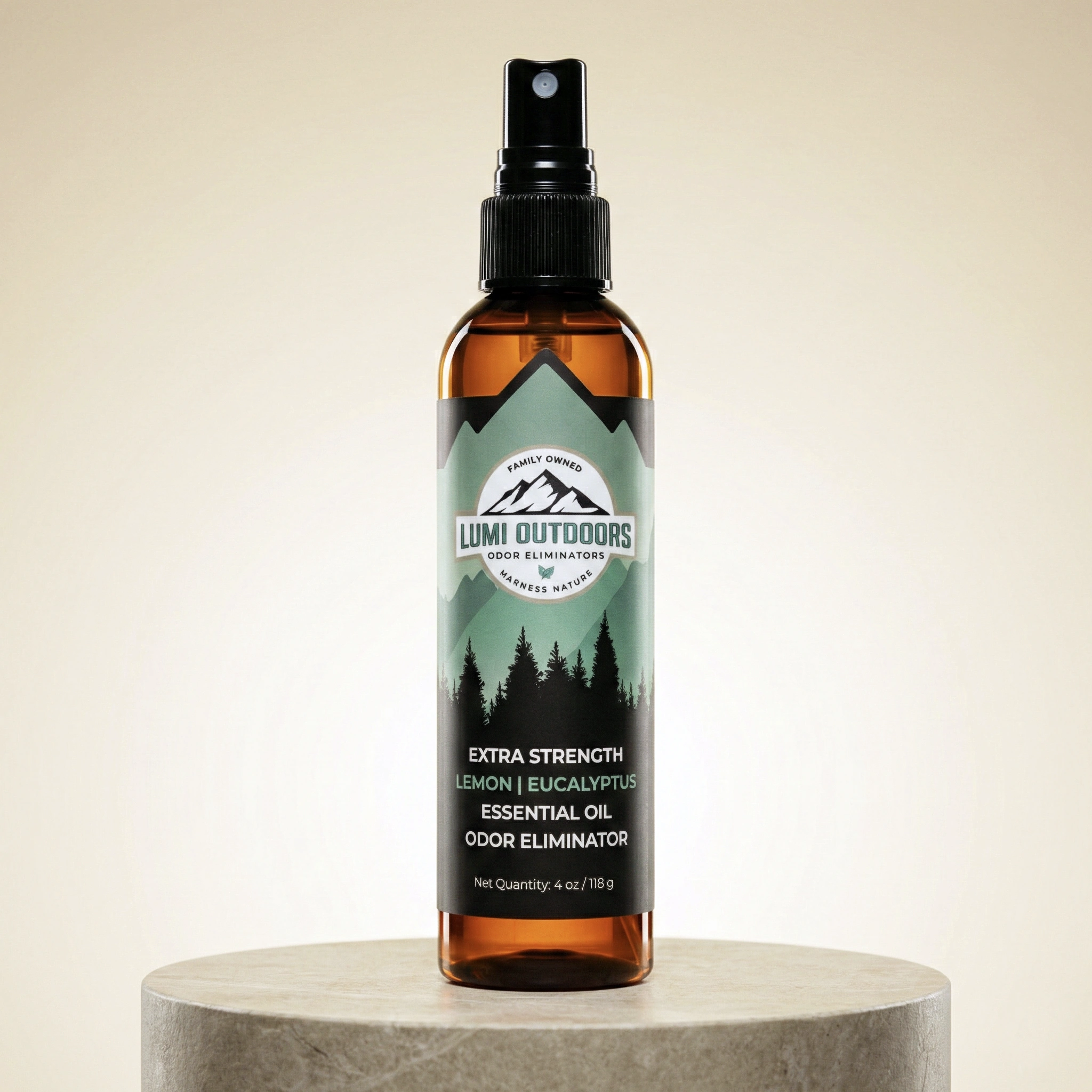
If you're dealing with severe, persistent leather boot odor — the kind that's survived baking soda, cedar trees, and half a can of aerosol — the Lumi Extra Strength Shoe Deodorizer Spray is built specifically for this. It uses a concentrated lemon eucalyptus formula without alcohol, parabens, or synthetic fragrance. The essential oils penetrate the leather matrix rather than sitting on the surface, which is what addresses the embedded bacterial residues the other methods can't reach.
One honest limitation: the eucalyptus scent is noticeable for about 10–15 minutes after application. It fades to neutral as it absorbs — but if you're spraying right before you need to wear the boots, plan for that window. Spray the night before when you can.
The plant-based formula is also safe for dogs at normal usage, but worth noting for households with cats: eucalyptus and citrus oils can be irritating to cats. Allow sprayed boots to fully dry in a closed closet before letting cats near them.
For a direct look at how this approach compares to conventional chemical alternatives, the breakdown at Lumi Outdoors vs. Arm & Hammer covers the ingredient-level differences in detail.
If you want to combine these methods with a targeted approach, here's what works:
What You'll Need
- Cedar shoe trees
- Leather conditioner (beeswax or lanolin-based)
- Extra Strength Shoe Deodorizer Spray Check Price →
- Newspaper (for moisture absorption during drying)
How Do You Safely Deodorize Leather Boots Step by Step?
The most effective process combines drying, treatment, and conditioning in a specific sequence — skipping the conditioning step is the most common mistake, and it's what causes long-term leather damage even when the deodorizing treatment itself is leather-safe.
Here's the actual process:
Step 1: Dry the boots completely before treatment. Wet leather doesn't absorb treatment sprays evenly — the water in the fiber matrix blocks penetration. After wearing, remove the insoles (wash them separately if removable), loosen the laces, and let the boots air in a ventilated space for at least 4 hours. A boot dryer works faster. Newspaper stuffed inside absorbs interior moisture effectively if you don't have a dryer — replace it after 2 hours for heavy sweaters.
Step 2: Apply the essential oil spray evenly to the boot interior. Hold the nozzle about 6 inches from the opening and spray in a slow arc to cover the toe box, sides, and heel area. You want even coverage, not saturation — over-applying adds unnecessary moisture. Let the spray absorb for 15 minutes minimum before wearing. If you're treating overnight, no timing pressure at all.
Step 3: Condition the leather after treatment. This step gets skipped constantly, and it's not optional. Even leather-safe treatments interact with the hide's surface chemistry. A light application of a quality leather conditioner — beeswax-based or lanolin-based formulas work well — after the spray dries maintains the leather's flexibility and creates a slight barrier against future bacterial penetration. Apply to exterior surfaces, not interior. This one step extends boot life measurably.
For severe odor cases — boots that have gone weeks without treatment, work boots worn 10+ hours daily — a single application may not fully resolve the smell. Apply for three consecutive nights before assessing. The bacterial residue in deeply penetrated leather takes more than one treatment cycle to address fully.
Many people dealing with persistent leather boot odor also wonder about other footwear types. The same principles apply to leather loafers and boat shoes — the science behind why leather shoes smell quickly is essentially the same bacterial chemistry at work.
How Do You Prevent Leather Boot Odor from Coming Back?

Consistent rotation and post-wear moisture management prevent the bacterial buildup that makes leather boot odor chronic — treating boots reactively after odor develops is significantly less effective than a simple weekly maintenance routine.
The most important habit: don't wear the same leather boots two days in a row. Leather needs 24–48 hours to fully off-gas and dry after a full day of wear. Wearing boots before they've dried completely means bacteria never experience a recovery interruption — the colony grows continuously rather than having its growth cycle broken.
Cedar shoe trees earn their place here. Insert them immediately after removing your boots — not the next morning. The first two hours post-wear are when the most moisture is present, and cedar absorbs most efficiently during this window. A quality pair of cedar shoe trees ($15–$30) will pay for themselves in extended boot life within a season.
A weekly maintenance spray — even when the boots don't smell — keeps bacterial colonies from re-establishing between wears. Think of it the same way you think about weekly conditioning: preventive maintenance is cheaper than repair. The essential oil formula works as a preventive at lower frequency than as a treatment for existing odor.
Sock choice matters more than most people realize. Cotton socks hold moisture against the foot, which accelerates both foot odor and boot odor. Wool or synthetic moisture-wicking blends transfer sweat away from the skin and reduce the moisture load that reaches the boot interior. The American Podiatric Medical Association consistently recommends moisture-wicking sock materials for patients managing foot odor — the same principle applies to boot longevity.
- Penetrates the leather fiber matrix to disrupt bacterial activity at the source — addresses the embedded residues that surface sprays miss
- No alcohol or synthetic solvents, so leather's natural oils stay intact across repeated use
- Plant-based essential oil formula is pH-compatible with leather's natural chemistry
- Works as both a reactive treatment for existing odor and a weekly preventive maintenance spray
- Customer reviews consistently report 48–72 hours of odor control per application in work boots
- Eucalyptus scent is noticeable for 10–15 minutes post-application — not ideal if you need to wear boots immediately
- Requires 3 consecutive nightly treatments for severe or long-neglected boot odor before full results are apparent
Stop reaching for the aerosol can as the default — it's treating leather the same way you'd treat a synthetic gym bag, and the chemistry genuinely doesn't transfer. One specific tip that rarely gets mentioned: after conditioning, a very light application of a neutral shoe cream on the interior heel (not the welt or sole) creates a slightly less porous surface in the highest-wear zone, which is where bacterial adhesion concentrates most heavily. Takes 30 seconds; meaningfully reduces odor recurrence in that specific area.
Ready to stop the chemical cycle and actually fix your leather boot odor?
Join 1 Million+ Other People Who Chose Lumi to Conquer Their Shoe Odor.
- DESTROYS ODOR AT THE SOURCE, DOESN'T JUST MASK IT
- ALL-NATURAL & PLANT-BASED INGREDIENTS
- PROUDLY FAMILY-OWNED & MADE IN UTAH
- THE "FRESH CONFIDENCE" GUARANTEE