
How to neutralize hockey skate odor and refresh your gear fast
- The Freezer Myth Cold temperatures pause bacteria, they don't eliminate them — odor returns within 30 minutes of thawing.
- Penetration Is Everything Hockey skate padding is 15-20mm thick, so surface sprays and powders that don't penetrate never reach where bacteria actually live.
- The Winning System A lemon-eucalyptus spray applied immediately post-game, combined with a moisture-absorbing powder before next wear, addresses both the cause and the enabling condition.
- Timing Wins Applying treatment within two hours of skating prevents odor compounds from setting into foam — waiting until morning is too late for severe cases.

Freezer bag, baking soda, dryer sheet, charcoal insert, essential oil spray — five common approaches to hockey skate odor, and every hockey parent has tried at least three. We evaluated them across four criteria: odor elimination mechanism, lasting effect, ingredient profile, and cost per use.
Spoiler: the freezer isn't doing what you think it is.
Why Do Hockey Skates Smell So Much Worse Than Regular Sneakers?
Hockey skates are uniquely bad odor generators because they combine dense foam padding, synthetic leather, zero ventilation, and a blade holder that traps heat — creating conditions where odor-causing bacteria like Brevibacterium linens and Staphylococcus epidermidis thrive and multiply rapidly after every skate.
A typical running shoe has a mesh upper. Air moves through it. Sweat evaporates. Hockey skates have none of that — the boot is essentially sealed once your foot is inside, and a single hour of play can generate significant moisture trapped against dense foam.
According to research published in the journal Applied Microbiology and Biotechnology, Brevibacterium linens — the same bacteria responsible for the smell of certain aged cheeses — produces bromodosis, the clinical term for foot odor, through the breakdown of sweat compounds into isovaleric acid. That's the specific molecule responsible for the "locker room" smell.
The padding thickness is the other factor nobody talks about. Most athletic shoes have 3–5mm of foam. Hockey skate interiors have 15–20mm of dense padding that soaks up sweat like a sponge and holds it there for hours. Standard deodorizers that spray the surface don't penetrate deep enough to reach where bacteria are actually living.
That's the real problem.
What Criteria Should You Use to Evaluate Skate Deodorizing Methods?
Before testing any method, establish four criteria: (1) odor elimination mechanism — does it mask, absorb, or neutralize at the source? (2) duration of effect beyond 24 hours, (3) ingredient profile, and (4) cost per application over a full season.
These criteria aren't arbitrary. Mechanism matters because masking an odor is just adding a second smell on top of the first one. Duration matters because hockey players skate multiple times per week — if a solution resets every 12 hours, it's not a solution. Ingredients matter because kids spend significant time with their faces near their gear. And cost-per-use over a 30-game season determines whether a $12 box of baking soda is actually cheaper than a $15 spray bottle.
Keeping those four criteria in mind, here's how each major method holds up.
Does the Freezer Method Actually Eliminate Hockey Skate Odor?
No. The freezer method puts bacteria into a dormant state, but it doesn't eliminate them. Once skates warm back up to room temperature, bacterial activity resumes — usually within 30 minutes — and the odor returns.
The freezer hack is one of the most persistent myths in sports gear maintenance. The idea is that cold temperatures kill odor-causing bacteria. But bacteria don't die at 32°F — they pause. The actual science behind why the freezer hack fails comes down to bacterial dormancy: most common skin bacteria survive freezing and resume metabolic activity during thaw.
On the four-criteria test: freezing scores zero on mechanism (dormancy isn't elimination), zero on duration (resets within hours of thawing), fine on safety, and it costs you a bag and some freezer space. The free part is appealing. The results aren't.
Verdict for freezing: Fine for passive maintenance if you enjoy the ritual. Not effective for the level of odor most hockey parents are dealing with.
Does Baking Soda Actually Work on Skate Odor, or Does It Make Things Worse?
Baking soda can temporarily reduce surface odors in lightly-used shoes, but inside hockey skates it often makes things worse — the alkaline powder reacts with sweat residue and creates a sour, compounded smell that's harder to eliminate than the original odor.
Baking soda's mechanism relies on its alkaline pH (around 9.0) temporarily disrupting the acidic environment bacteria prefer. That works on a countertop. Inside a skate boot that's saturated with sweat — which is slightly acidic and loaded with proteins — the reaction produces a distinctive sour byproduct smell. Multiple threads in r/hockeyplayers report this exact experience: pouring baking soda into well-used skates and having the odor worsen after the first application.
There's also the penetration problem. Baking soda is a powder that sits in the toe box. It can't wick into 15mm of dense padding where most of the bacteria actually live. And the chemistry of baking soda mixed with sweat explains exactly why this backfires in high-sweat footwear.
On the criteria: mechanism is pH disruption only (not neutralization), duration is under 24 hours before odor rebounds, safety is fine, and cost is essentially free. Baking soda is a legitimate tool for low-intensity footwear. Hockey skates aren't low-intensity footwear.
Verdict for baking soda: Best for light-use shoes or as an overnight option between gentle wears. Wrong tool for gear that takes 90-minute on-ice beatings three times a week.
Most hockey parents spray the opening of the skate and call it done. The real move is to angle the nozzle toward the toe box and spray along the inner seam on both sides — that's where Brevibacterium linens colonies concentrate because body heat and compression are highest there. Two targeted sprays into those seams outperform five sprays aimed at the ankle opening.
Do Dryer Sheets or Charcoal Inserts Actually Eliminate Skate Smell?
Dryer sheets mask odor with synthetic fragrance — they don't neutralize anything. Charcoal inserts genuinely absorb odor molecules and perform well as a passive overnight tool, but their absorption capacity saturates over time and they need regular replacement or recharging in sunlight.
Let's separate these two. Dryer sheets are purely olfactory camouflage. You're adding a "fresh linen" scent on top of isovaleric acid. The result is what hockey parents describe as "perfumed locker room" — somehow worse than the original. On mechanism: zero. On duration: 2–4 hours before the bacterial odor overpowers the fragrance. Not worth discussing further.
Charcoal inserts are genuinely good. Activated charcoal has a surface area of roughly 1,000 square meters per gram, giving it serious odor-molecule absorption capacity. Brands like Marsheepy and Zederna cedar insoles work on this principle. The real limitation: absorption isn't neutralization. Charcoal fills up and stops working. Most inserts need sun-recharging every 1–2 weeks, and heavily-used hockey gear can saturate a set of inserts faster than that.
Charcoal inserts also can't penetrate padding. They sit in the skate and absorb what reaches them. They won't touch the bacteria colonizing foam three centimeters away.
Verdict for charcoal inserts: The strongest passive overnight option available. Genuinely recommended for ongoing maintenance between games. But for acute post-game odor in serious gear, they're not enough on their own.
So we know what doesn't work, or only partially works. Now: what actually eliminates the smell at the source?
How Well Do Plant-Based Essential Oil Sprays Work on Hockey Gear Odor?

Sprays formulated with lemon eucalyptus essential oil neutralize isovaleric acid and other odor compounds on contact — a different mechanism than masking or absorption — and penetrate padding more effectively than powders when applied directly into the toe box and seams.
The key compound is eucalyptol (1,8-cineole), the primary active component in eucalyptus oil. Research from the Journal of Clinical Microbiology documents eucalyptol's effectiveness against common skin bacteria including Staphylococcus epidermidis, the main species colonizing athletic footwear. Combined with the citric acid profile of lemon oil — which lowers the pH environment that bacteria require — lemon-eucalyptus formulas address the problem mechanically rather than cosmetically.
The spray format matters here. A liquid penetrates foam padding in a way that a powder simply cannot. Two or three direct sprays into the toe box and along the inner seams reach odor that a surface treatment never touches.
Honest limitations of this approach: the lemon eucalyptus scent is noticeable for the first 10–15 minutes after application, then fades to neutral. And the spray needs about 15 minutes to dry before you can wear the skates again. If you're in a rush between periods, that's a real constraint.
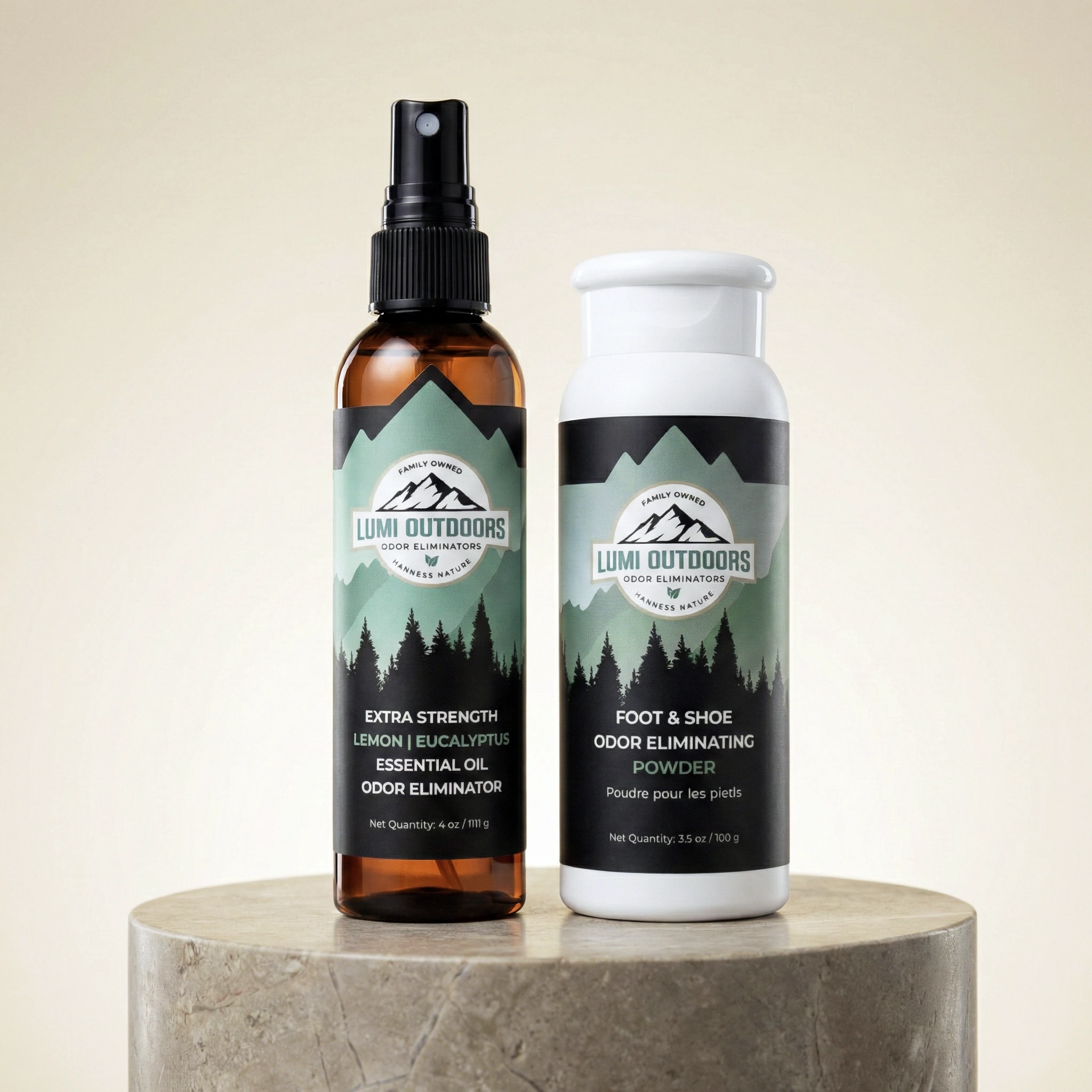
If you want to go beyond a single spray and build a system, combining a targeted spray with a moisture-absorbing powder creates the dual-action approach that experienced hockey parents swear by. The most efficient way to get both is the Natural Foot Powder and Extra Strength Shoe Deodorizer Spray bundle, which pairs proactive moisture defense with reactive odor elimination in one kit.
What You'll Need
- Microfiber cloth (for post-game wipe-down of boot exterior and ankle collar)
- Mesh gear bag or drying rack (for open-air drying after each session)
- Natural Foot Powder and Extra Strength Shoe Deodorizer Spray Check Price →
- Cedar shoe inserts (for passive overnight odor absorption between games)
Here's how the approaches compare across all four criteria:
| Feature | Natural Spray + Powder | Charcoal Inserts | Baking Soda | Freezer Method |
|---|---|---|---|---|
| Odor elimination mechanism | Neutralizes odor with eucalyptol and citric acid compounds | Absorbs odor molecules passively | Temporary pH disruption only | Bacterial dormancy — not elimination |
| Foam padding penetration | Liquid spray reaches 15-20mm deep into padding | Sits on surface only — no penetration | Powder stays in toe box — no penetration | No penetration — affects surface only |
| Duration of effect | 24-48 hours per application | Ongoing while capacity remains (2-4 weeks) | Under 24 hours before odor rebounds | Resets within 30 minutes of thawing |
| Ease of use | 2-minute post-game spray routine required | Set-and-forget — no daily effort needed | Pour in and shake — very simple | Requires bagging and freezer space overnight |
| Cost per season (30 games) | ~$15-20 for full season | ~$10-15 per set, replacement every 2-4 weeks | Under $2 — essentially free | Free if you own a freezer |
What Is the Best Step-by-Step Protocol for Eliminating Hockey Skate Odor After a Game?
The most effective post-game protocol takes under five minutes and involves four steps: immediate skate removal, a surface wipe-down, direct spray into the toe box and seams, and powder application to insoles and socks before the next wear.
Timing is everything. Most odor compounds set into foam padding within two hours of the skate ending. The window where a spray is most effective is immediately post-game, not the following morning when the skates have been sitting in a closed bag for 12 hours.
Step 1: Extract and Separate
Remove skates immediately after leaving the ice. Pull the insoles out completely and set them separately. This doubles the surface area exposed to air and cuts drying time by roughly half. It sounds obvious. Most people don't do it.
Step 2: The Quick Wipe-Down
Use a clean microfiber cloth to wipe down the exterior of the boot, the blade holders, and especially the inside of the ankle collar. Sweat and salt residue on these surfaces isn't just an odor issue — it breaks down materials over time. A 60-second wipe now saves a $300 skate later.
Step 3: Targeted Spray Application
This is where the Extra Strength Shoe Deodorizer Spray earns its place. Spray 2–3 times directly into the toe box (angling the nozzle toward the far end), once along each inner seam, and once into the ankle padding. Don't just mist the opening. The bacteria are deep in the foam — the spray needs to reach them. Let the skates air-dry with the tongue pulled back and the insoles out. A mesh gear bag, unzipped, works better than a sealed hockey bag.
Step 4: Moisture Defense for Next Game
Before the next wear, lightly dust the insoles and your socks with foot powder. This creates a moisture barrier that slows bacterial recolonization from the start of the session. You're not just reacting to odor — you're making it harder for odor to develop in the first place. Think of the powder as your pre-game move and the spray as your post-game move.
That combination is exactly why the powder-and-spray system exists as a bundle. Two different problems, two targeted tools.
How Do You Refresh an Entire Hockey Bag and the Gear Inside It?

The most effective bag refresh strategy starts with airflow: unzip the bag completely after every use and store it open in a ventilated area. For soft gear — gloves, elbow pads, shoulder pads — a light spray treatment and a 30-minute air-dry session eliminates the majority of lingering odor.
The unzipped bag is the most underrated move in hockey parent maintenance. A sealed hockey bag is essentially a sealed fermentation chamber. Bacteria keep working for hours after the game ends. An open bag lets moisture escape and slows bacterial activity significantly.
For gloves specifically: they're the worst offenders in most bags because they're held tightly in both hands for the entire game. Spray the interior of each glove and hang them palm-down over a drying rack. Gravity helps the spray penetrate toward the fingertips where odor concentrates. Don't skip elbow pads and shoulder pads — they hold moisture in the foam just like skates do.
Weekly routine: once a week, pull everything out of the bag and do a full 30-minute air-out in a well-ventilated space. This is the "deep air" session. Daily routine: the post-game spray protocol above. The weekly session resets the baseline; the daily protocol keeps it from rebuilding.
One more thing worth knowing: the interior fabric of most hockey bags is a breeding ground on its own. A few sprays along the inside seams of the bag once a week cuts the ambient odor dramatically — even before you open it.
Hockey Parent FAQ: Car Trips, Sensitive Skin, and Sudden Odor Emergencies
The most common hockey parent questions are about safety, car odor after tournaments, and what to do when good hygiene habits still aren't enough — all of which have direct, practical answers.
Is it safe to use isopropyl alcohol on skate liners?
Isopropyl alcohol can sanitize surfaces effectively, but it's harsh on synthetic foam and leather — it dries out materials and can cause cracking in skate liners over repeated use. The skin safety facts around isopropyl alcohol also suggest it strips beneficial skin flora when used directly on feet, which can actually worsen odor over time. For skate liners, a plant-based spray is safer and more effective long-term.
How do you refresh car upholstery after a tournament weekend?
Hockey gear odor soaks into fabric seats fast. After unloading the car, leave all windows down for at least an hour if weather permits. For seats, a light spray of the same essential oil deodorizer on the fabric (not leather) and a 20-minute air-dry eliminates most of the absorbed odor. A cedar car diffuser helps maintain a baseline between events.
What if good hygiene habits still aren't stopping the smell?
This happens more often than people expect, and it's rarely about hygiene. Why shoes suddenly stink even with perfect hygiene usually comes down to bacterial colonization that's already set deep in the padding — at that point, surface-level habits don't reach it. A direct spray treatment into the foam, repeated for 3–5 consecutive days, is typically what breaks the cycle.
Are essential oil sprays safe for kids with sensitive skin?
Essential oils can bother sensitive skin, and the main exposure is contact with damp gear after spraying. Let sprayed skates dry fully (15 minutes minimum) before your child puts them on. If your child has known citrus or eucalyptus sensitivity, test on a small area of the liner first. The spray is applied to the equipment, not directly to skin — that distinction matters for sensitive-skin households.
One specific note for cat households: eucalyptus and citrus oils can be irritating to cats if directly contacted or heavily inhaled. Store sprayed skates in a closed closet or separate room until fully dry if your cat has access to the gear area.
The Verdict: What Does the Evidence Actually Say About Hockey Skate Odor?
Based on mechanism, duration, and penetration depth, a plant-based essential oil spray — used immediately post-game with a moisture-absorbing powder before next wear — is the most effective system for managing hockey skate odor. No single passive method comes close for high-use gear.
The freezer doesn't eliminate bacteria — it pauses them. Baking soda backfires in high-sweat environments. Dryer sheets add a second smell. Charcoal inserts are genuinely good for passive maintenance but won't handle acute post-game odor in heavily-used skates. The spray-plus-powder system addresses both the cause (bacteria in foam) and the enabling condition (moisture) simultaneously.
If you're a hockey parent who has already tried most of these methods and found them underwhelming, the problem likely isn't effort — it's tool selection. Dense foam padding requires penetration, not surface treatment.
The one tip most guides skip entirely: start the spray protocol on day one of a new pair of skates, before they've developed established bacterial colonies. It's dramatically easier to maintain freshness than to restore it after a full season of buildup.
- Lemon eucalyptus formula targets odor at the source rather than masking with synthetic fragrance
- Spray format penetrates dense foam padding — addresses odor that surface treatments never reach
- Powder component prevents moisture buildup proactively, not just reactively
- Bundle pricing makes the complete two-step system more economical than buying separately
- Spray requires 15 minutes of dry time before wearing — not ideal for quick turnarounds between periods
- Eucalyptus and citrus oils require caution in cat households — sprayed gear must be stored in a closed room until fully dry
Ready to stop dreading the drive home from the rink?
Join 1 Million+ Other People Who Chose Lumi to Conquer Their Shoe Odor.
- THE ULTIMATE 1-2 PUNCH AGAINST ODOR
- A COMPLETE KIT FOR SHOES, BAGS & GEAR
- PROUDLY FAMILY-OWNED & MADE IN UTAH
- THE "FRESH CONFIDENCE" GUARANTEE