
The Hidden Truth: Does Rubbing Alcohol Actually Fix Stinky Shoes?
- It works — briefly Rubbing alcohol kills surface bacteria on contact, but evaporates in under a minute and never reaches the bacterial colonies living deep in shoe foam.
- The smell comes back because of biofilms Established shoe odor involves structured bacterial communities that shield themselves from quick-drying surface sprays — alcohol included.
- Permanent fix requires three steps Remove the organic buildup, control moisture, and use an agent that stays on the fabric long enough to actually disrupt bacterial growth.

Rubbing alcohol does kill odor-causing bacteria on contact — but the smell comes back, usually within a day or two. Isopropyl alcohol evaporates in seconds, which means it rarely penetrates the dense foam and fabric where bacterial colonies actually live. It's a temporary reset, not a fix.
Here's what's actually going on inside your shoes, and what it takes to get rid of the smell for good.
Why Does Rubbing Alcohol Work at All — and Why Does the Smell Return?
Isopropyl alcohol eliminates surface bacteria through protein denaturation — it breaks down cell walls on contact. But it evaporates so fast (within 30–60 seconds on most surfaces) that it can't reach the deeper bacterial communities embedded in your insole foam and fabric lining.
The bacteria responsible for that signature locker-room stench are primarily Brevibacterium and Staphylococcus epidermidis. These organisms thrive in warm, moist environments — exactly what the inside of a worn athletic shoe provides. When alcohol hits the surface, it does a real job on what it touches. The problem is the geography.
A typical athletic shoe insole can be 8–12mm thick, and the foam is porous enough to absorb sweat deep into its structure. Alcohol evaporates before it ever gets there. So you've cleaned the top layer, but the colony living three millimeters down is completely unaffected.
That's the real problem.
There's also the food source issue. Bacteria don't just appear — they eat the organic material your feet leave behind: dead skin cells, sweat residue, and oils. Alcohol kills bacteria on contact but doesn't remove any of that organic buildup. So within 24–48 hours, the surviving bacteria from the deeper layers have migrated back to the surface and started feeding again. You haven't solved anything. You've just delayed it.
What Is a Biofilm, and Why Does It Matter for Shoe Odor?

A biofilm is a structured community of bacteria encased in a self-produced protective matrix — essentially a microscopic shield that makes the colony dramatically harder to disrupt with surface treatments like alcohol sprays.
This isn't obscure science. According to the National Institutes of Health, biofilms account for the majority of persistent bacterial infections and surface colonization in moist environments. Your shoe insole qualifies as exactly that kind of environment.
Most people spray alcohol into shoes right before wearing them — that's the worst possible timing. Alcohol needs a dry surface and dwell time to work. Spraying into a shoe that still has residual moisture from yesterday's wear means the alcohol dilutes instantly and evaporates before it can do anything. If you're going to use alcohol at all, spray into completely dry shoes, let them sit open for 20–30 minutes, then stuff with cedar or newspaper before storing.
Once a biofilm establishes itself in porous shoe material, a quick spray of anything — alcohol, Febreze, vinegar — mostly bounces off the outer matrix. The bacteria inside are protected. This is why shoes that "used to smell fine" suddenly develop a chronic odor that nothing seems to fix. The biofilm reached critical mass. You've crossed a threshold.
Contrast this with what alcohol does well: it's genuinely effective on hard, non-porous surfaces like the rubber outsole, the inside of a locker, or a hard plastic insole shell. On those surfaces, there's nowhere for bacteria to hide, and the contact kill is complete. The issue is that soft athletic shoes aren't those surfaces. Not even close.
This is also why freezing shoes fails by the same logic — cold temperatures pause bacterial activity but don't eliminate the biofilm or the organic material feeding it. The smell returns at room temperature every single time.
What Actually Gets Rid of Shoe Odor for Good?
Permanent odor elimination requires three things: removing the organic buildup that feeds bacteria, controlling the moisture that triggers growth, and applying an agent that disrupts bacterial activity without evaporating in under a minute.
Start with a deep clean. Pull the insoles out — most are removable — and wash them with warm water and a small amount of dish soap. This physically removes the accumulated sweat and dead skin that alcohol leaves completely intact. For the shoe interior, a damp cloth with a tiny drop of soap works on the lining. Let everything air dry completely before reassembling — at least 12 hours. Skipping the drying step is how most people immediately undo their own work.
Moisture control comes next, and it's the step most people skip entirely. Bacteria need water to reproduce. If you eliminate the moisture, you dramatically slow the regrowth cycle. Cedar shoe trees are the classic solution — cedar naturally absorbs moisture and has a mild odor-neutralizing effect of its own. Baking soda packed into the toe box overnight is a genuinely effective free alternative that pulls moisture without any chemicals involved.
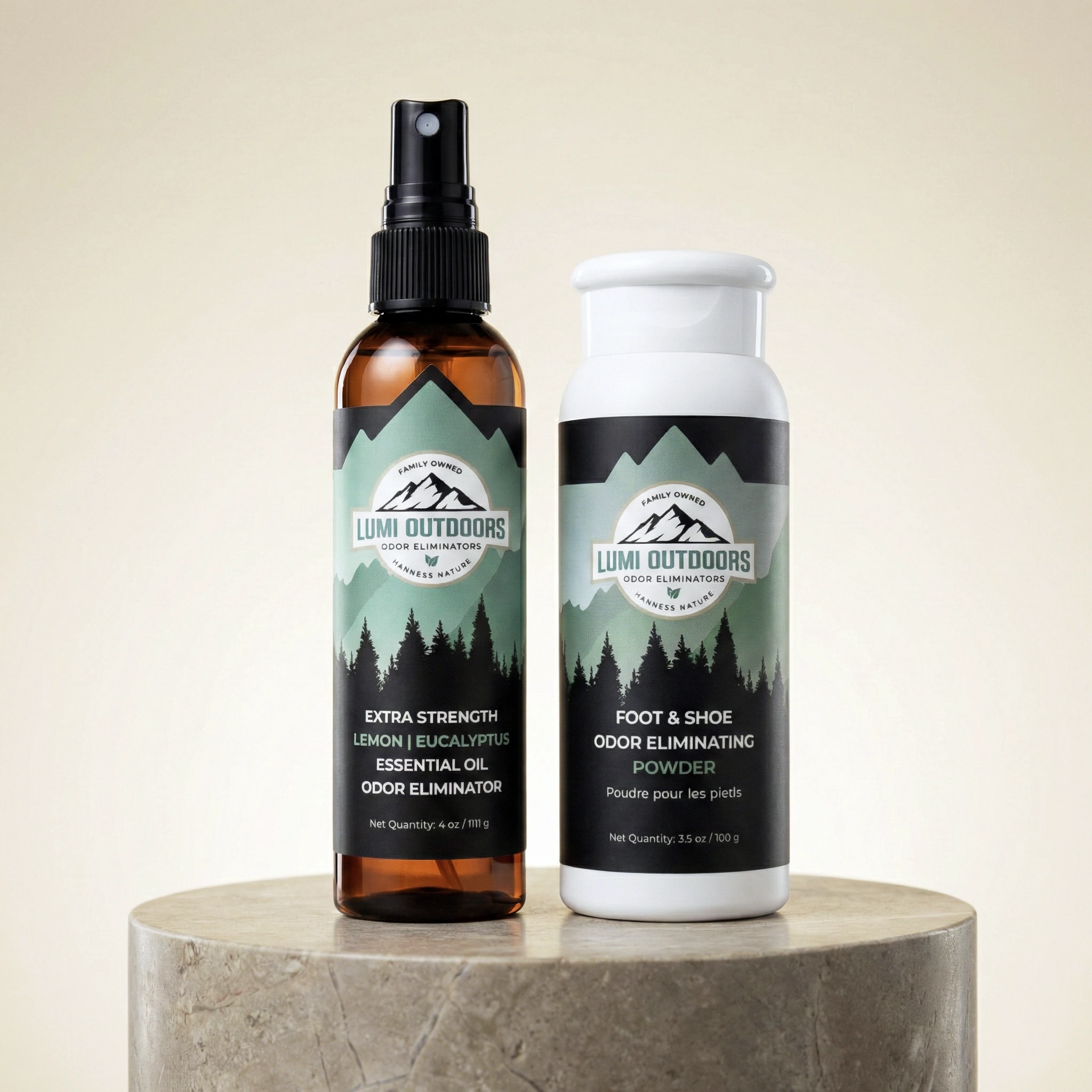
For the third step — ongoing bacterial suppression — essential oil-based sprays outperform alcohol because they don't evaporate instantly. Lemon eucalyptus and tea tree oil both disrupt bacterial cell membranes through a different mechanism than alcohol, and they linger on the fabric surface long enough to actually work. The Lumi Natural Foot Powder and Extra Strength Shoe Deodorizer Spray bundle handles both the moisture control and the ongoing neutralization in one system — the powder goes on your feet before you put your shoes on, and the spray treats the shoe itself after you take them off.
For a deeper breakdown of building this kind of routine, this 3-step guide for gym shoes is worth reading — the same logic applies to any athletic footwear.
Will Rubbing Alcohol Damage Your Shoes Over Time?
Yes — repeated alcohol use can cause real material damage, particularly to leather, adhesive bonds, and synthetic coatings. The risk scales with frequency: one-time use is unlikely to cause visible damage, but weekly use over months will degrade most shoe materials.
Leather is the most vulnerable. Isopropyl alcohol strips the natural oils from leather fibers, causing the surface to dry out and eventually crack. Even full-grain leather — the most durable kind — loses suppleness after repeated alcohol exposure. If you're treating leather dress shoes or boots, check this breakdown of alcohol's effect on leather before you reach for the bottle again.
Modern sneakers present a different problem. The midsole-to-upper bond in most athletic shoes uses EVA or polyurethane adhesives that alcohol can slowly dissolve. You won't see it immediately — it shows up as the sole starting to separate at the toe after a few months of use. By then, the connection to the cause isn't obvious.
There's also a skin angle worth knowing. Alcohol residue left inside a shoe can transfer to foot skin, particularly in people who wear shoes without socks. Repeated exposure dries the skin, and in people prone to eczema or contact dermatitis, it can trigger peeling or cracking — especially around the heel and ball of the foot. The American Academy of Dermatology identifies isopropyl alcohol as a known contact irritant at repeated-exposure concentrations.
The short version: alcohol is a decent emergency measure. It's not a maintenance strategy. Using it once to knock back a bad smell before a big day? Fine. Spraying it into your teenager's cleats every night after practice? You're going to be buying new cleats sooner than you planned.
And the smell will still be there.
Done with the temporary fixes that let the smell come back?
Join 1 Million+ Other People Who Chose Lumi to Conquer Their Shoe Odor.
- THE ULTIMATE 1-2 PUNCH AGAINST ODOR
- A COMPLETE KIT FOR SHOES, BAGS & GEAR
- PROUDLY FAMILY-OWNED & MADE IN UTAH
- THE "FRESH CONFIDENCE" GUARANTEE