
Shoes Still Smell Bad? 8 Advanced Hacks for 'Unfixable' Footwear
- The Source Is Deep Shoe odor embeds itself in foam and fiber via a bacterial biofilm that surface sprays and baking soda cannot fully penetrate.
- Free Methods First Pulling insoles out after every wear and rotating shoes on a 48-hour schedule eliminates a large portion of odor before it becomes chronic.
- Escalate Strategically When DIY methods hit their ceiling, essential oil sprays and ozone treatment target the embedded bacteria that household fixes miss.

If you've already tried baking soda, dryer sheets, the freezer trick, and three different sprays — and your shoes still smell like a locker room — the problem isn't your effort. It's that standard fixes target the symptom, not the source. The odor lives inside a bacterial biofilm embedded in foam and fiber, and surface-level treatments barely graze it.
These 8 methods are ranked from accessible to aggressive. Start where you are. The first two cost nothing. The last one involves ozone. Most people find their answer somewhere in the middle.
1. Pull the Insoles Out and Actually Dry Them
Remove your insoles after every wear and let them dry separately for at least 8 hours. Most shoe odor originates in the insole foam — a dense, moisture-trapping material that stays damp for 24–48 hours when left inside the shoe, creating ideal conditions for bacterial growth.
This sounds obvious. Almost nobody does it consistently. The foam in modern insoles — particularly EVA (ethylene-vinyl acetate) — is engineered for cushioning, which means it's also engineered to hold moisture. Leaving insoles inside a closed shoe after a workout is essentially creating a sealed incubator.
Pull them out. Set them on a rack, not a flat surface. Both sides need airflow. If you can put them near a fan or in front of an AC vent, do it. Eight hours minimum — 12 is better for thicker foam. This single habit eliminates a significant chunk of odor buildup before it has a chance to embed itself in the material.
If your insoles are permanently glued in, skip ahead to Hack #2.
2. Replace the Factory Insoles Entirely
Factory insoles in most athletic shoes are thin, low-density foam with no odor-control properties. Swapping them for activated charcoal or copper-infused replacement insoles can dramatically reduce odor by absorbing sweat and disrupting the bacterial environment at the source.
Most factory insoles are cheap. They're included because they provide basic cushioning during fitting — not because they're designed for long-term moisture management. After a few months of regular use, they're saturated with dead skin cells and sweat residue that no amount of spraying will fully fix.
Activated charcoal insoles (brands like Zederna make a cedar-charcoal hybrid worth looking at) work by physically adsorbing moisture and odor compounds. They're not a forever solution — replace them every 3–4 months — but they address the problem at the layer where it actually starts. For permanently glued insoles, use a flat tool to gently work them free. Most "permanent" insoles aren't as permanent as they seem.
Most people spray the insole surface and call it done. The actual target is the sidewall foam and the toe box — the two areas where bacteria concentrate because they receive the least airflow and the most pressure-transferred sweat. Tilt the shoe and spray those walls directly, let the shoe sit on its side for 5 minutes to let the liquid migrate down into the toe box, then stand it upright to dry. That contact-time trick is what separates a real treatment from a quick freshen.
3. Stop Freezing Your Shoes — Here's Why It Doesn't Work
Freezing makes odor-causing bacteria dormant, not dead. The smell returns within minutes of the shoes warming back up, making this method a temporary illusion of freshness rather than a real fix.
The freezer trick is everywhere online, and it sounds logical — cold kills things, right? Not exactly. The primary odor-causing bacteria in shoes (Micrococcus and Corynebacterium, specifically) are cold-tolerant organisms. They go dormant below a certain temperature, then resume metabolizing sweat and producing isovaleric acid — the compound responsible for that sharp, vinegar-meets-gym-sock smell — the moment they warm up again.
Cold also does nothing to the structural problem: a biofilm matrix that bacteria build inside foam and fiber to protect their colony. That biofilm survives the freeze entirely intact. We've written a full breakdown of why freezing your shoes for odor is a total waste of time if you want the complete science. The short version: skip it.
Same goes for baking soda, mostly. It neutralizes some surface odor through a basic acid-base reaction, but it can't penetrate foam deeper than a few millimeters. The baking soda trap is real: it gives you a brief window of freshness and then the smell comes back, often worse, because you've done nothing to the colony underneath.
4. Try the Isopropyl Alcohol Wipe Method
Wiping the interior of non-leather shoes with 70% isopropyl alcohol disrupts the outer layer of bacterial colonies and dissolves some of the oil-based residue they feed on — a targeted mid-level fix that goes further than sprays without requiring specialized equipment.
Use a cloth or cotton pad soaked in 70% isopropyl alcohol (not 90%+ — the lower concentration is more effective because it evaporates slower and has longer contact time). Wipe every interior surface: the toe box, the sides, the heel cup. Let the shoe air dry completely — usually 20–30 minutes — before wearing.
This works particularly well on synthetic mesh uppers and rubber interiors. Do not use it on leather — it strips conditioning oils and causes cracking. For leather footwear, the root cause of work boot odor is a different problem requiring leather-safe approaches.
Isopropyl wipes won't crack deep biofilm, but they're a solid reset for shoes that are moderately saturated — think weekly maintenance rather than one-time cure.
5. Use Zinc and Kaolin Powder as a Hostile Moisture Barrier
Applying a zinc-based or kaolin clay foot powder inside shoes before wearing creates an inhospitable environment for moisture accumulation — addressing the root condition that allows bacteria to thrive in the first place.
Most people treat shoe odor reactively. Powder flips that logic. Zinc oxide and kaolin clay are both highly absorbent minerals that work by pulling sweat away from the foam before it can saturate the material. No moisture = bacterial colonies can't reproduce at the rate that generates odor.
Dust the powder into the insole area before putting shoes on, not after. The goal is to intercept sweat at the point of contact. This approach is especially effective for athletes and people who wear the same pair daily — exactly the situation where reactive treatments always fall short. A talc-free foot powder with zinc is the move here.
6. Target the Embedded Odor with an Essential Oil Spray

For odor that's embedded in foam liners — the layer that baking soda and surface wipes can't reach — a concentrated essential oil spray with eucalyptus or tea tree disrupts the bacterial environment at a deeper level than water-based deodorizers.
Essential oils like lemon eucalyptus and tea tree have well-documented properties that disrupt bacterial cell membranes, according to research reviewed by the National Institutes of Health. Applied via a spray that penetrates into the foam rather than just coating the surface, they reach deeper into the material than powders or wipes alone.
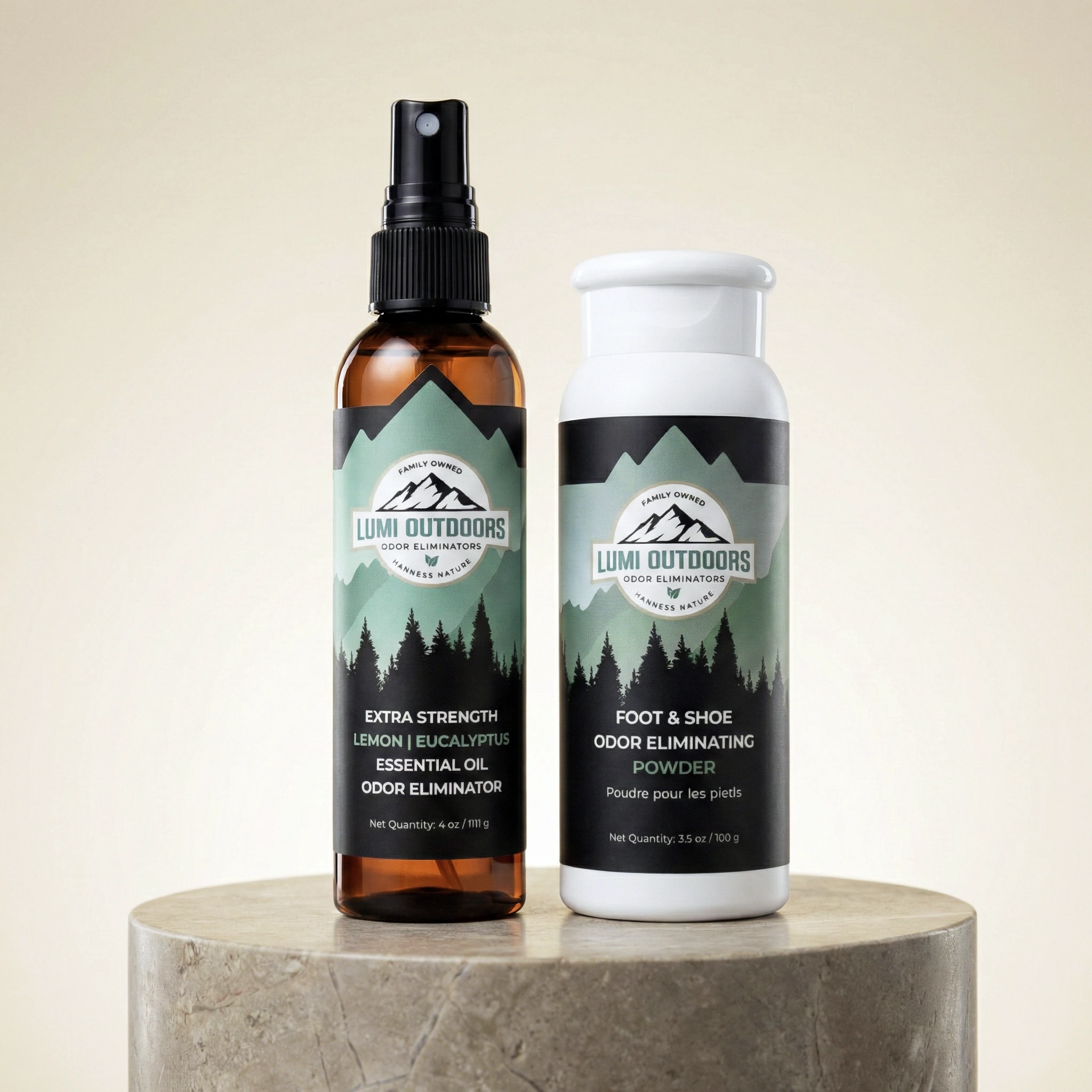
The technique matters as much as the product. Saturate the interior — don't mist. Let it sit for 15–20 minutes before the foam dries. The goal is contact time with the bacterial colony, not just a quick spritz. The Lumi Extra Strength Spray is formulated specifically for this — the lemon eucalyptus scent is noticeable for the first 10 minutes or so, then fades to neutral. It needs about 15 minutes to dry before you wear the shoes, which is an honest trade-off for actual penetration depth.
For the most stubborn cases — shoes that have survived everything above — pairing the spray with a daily powder application is the most effective system available without power tools.
7. Alternate Your Shoes on a 48-Hour Rotation
Shoes need a minimum of 48 hours to fully dry at the foam core level. Wearing the same pair on back-to-back days prevents complete moisture evaporation, which means the bacterial colony never encounters a dry enough environment to slow its growth.
This is free. It costs nothing except owning two pairs.
The American Podiatric Medical Association has long recommended shoe rotation as a standard hygiene practice — and the mechanism is straightforward. EVA foam, the material in most modern midsoles and insoles, holds moisture in its cellular structure well beyond what the surface feels like to the touch. A shoe that feels dry after 24 hours often still has residual moisture in the foam core — enough to sustain bacterial growth through another full wear cycle.
Monday-Wednesday pair, Thursday-Saturday pair. Rotate on rest days. If you're a daily runner or spend 10+ hours in work boots, this isn't optional — it's the structural fix that makes everything else work longer. Without it, you're constantly fighting a colony that never fully loses its foothold.
8. The Nuclear Option: Ozone Treatment
For shoes that have survived every other method, ozone generators produce O₃ molecules that oxidize and break down the organic compounds (including biofilm) that bacteria use as both food and protection — making this the most aggressive non-destructive odor treatment available for home use.
Ozone treatment is legitimate science, not a gimmick. Ozone (O₃) is an unstable molecule that reacts with and oxidizes organic material on contact. In the context of shoes, it reaches the toe box and deep foam areas that sprays struggle to penetrate, because it disperses as a gas throughout the interior rather than relying on liquid absorption.
You can buy a compact shoe ozone sanitizer for $30–$60 online. Place the emitters inside the shoes, run a cycle of 20–30 minutes in a ventilated area (the ozone smell is strong — do this outside or in a garage). Do not breathe concentrated ozone directly. Let the shoes air out for 30 minutes after the cycle before wearing. For shoes that have genuinely resisted everything else, this is the last method before you consider replacement. Customer reviews of ozone shoe devices consistently report success on footwear that was otherwise destined for the trash.
When Should You Actually Throw the Shoes Away?
If fresh socks smell bad within 10 minutes of wearing a specific pair of shoes, or if you can see visible mold or feel structural breakdown in the midsole foam, the bacterial load has likely surpassed what any at-home treatment can fully address.
There's a real threshold here. Shoe odor exists on a spectrum: surface contamination that responds to treatment on one end, and deep structural saturation on the other. The "fresh socks test" is a genuine field diagnostic — if clean socks pick up odor that fast, the shoe interior is transferring bacteria directly to the fabric on contact. That's a critical load.
Visible mold is a separate issue entirely. Bromodosis (chronic foot odor) caused by fungal growth requires medical-grade intervention, not household hacks. If the midsole foam has visible compression failure — flat spots, cracking, or visible breakdown — the bacteria have likely colonized areas that are physically unreachable. At that point, new shoes are the correct answer, not more treatment.
The good news has a number attached to it: most shoes aren't there yet. If you've been relying on surface sprays and the freezer trick, you probably haven't actually tried the methods above. Work through the list before you write the shoes off.
One last tip that didn't make the numbered list: store shoes with the tongue pulled open and the laces loosened. A shoe stored in its natural "closed" position traps whatever moisture is left inside. Thirty seconds of opening them up after each wear is the kind of micro-habit that compounds over months — and it's the difference between shoes that stay manageable and shoes that end up in the trash at six months.
Still fighting the same shoes every week?
Join 1 Million+ Other People Who Chose Lumi to Conquer Their Shoe Odor.
- THE ULTIMATE 1-2 PUNCH AGAINST ODOR
- A COMPLETE KIT FOR SHOES, BAGS & GEAR
- PROUDLY FAMILY-OWNED & MADE IN UTAH
- THE "FRESH CONFIDENCE" GUARANTEE